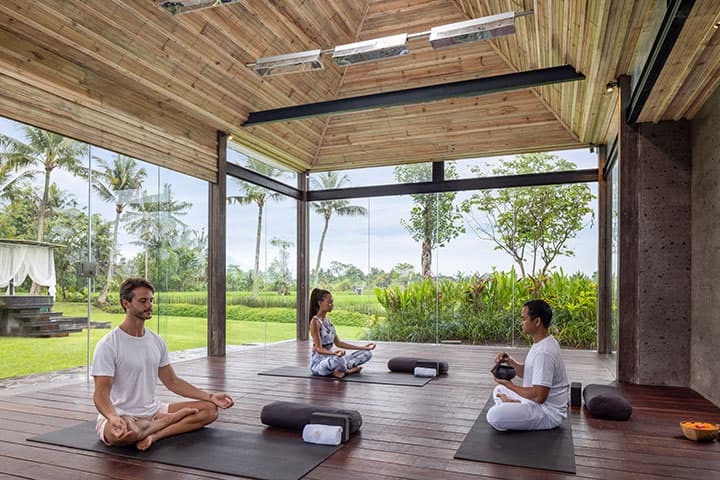


A burnout retreat is a structured residential break from sustained workplace pressure, combining protected rest, guided movement, nourishing routines and reflection.
Unlike an ordinary holiday, it reduces daily decisions and creates a deliberate recovery sequence. It can support perspective and planning, but it does not diagnose burnout, provide rehabilitation or guarantee recovery.
For a broader explanation of that sequence, read how the Bali reset retreat combines mental, physical, behavioural and nervous-system practices across six structured days.
What Burnout Actually Looks Like
The World Health Organization describes burnout as an occupational phenomenon caused by chronic workplace stress that has not been successfully managed.
Its three dimensions are exhaustion, greater mental distance or cynicism toward work, and reduced professional efficacy.
Common burnout examples include waking tired, dreading routine tasks, becoming unusually irritable and needing increasing effort for ordinary decisions.
Other signs may include disturbed sleep, poor concentration, emotional detachment and coping through constant scrolling, alcohol, overwork or avoidance.
Executive burnout symptoms can be easy to hide because output may continue after recovery capacity has declined.
A leader may remain productive in public while sleep, patience, memory and relationships deteriorate privately.
Burnout is not a personal weakness, and recovery is not simply a matter of trying harder at self-care.
Read the guide to signs of burnout you might be ignoring.

What Is a Burnout Recovery Retreat?
Burnout recovery retreats are structured wellness programmes combining deep rest, supportive therapies, guided movement and reflection for people experiencing sustained physical and mental exhaustion.
They may help guests interrupt stress routines and plan healthier boundaries. They do not “heal” burnout on a fixed timetable or replace changes to unsafe work conditions.
Deep Rest
Schedules should protect sleep, quiet transitions and genuine unscheduled time rather than replacing work pressure with continuous wellness activities.
Digital boundaries can reduce routine notifications while preserving an emergency contact route agreed before arrival.
Body-Based and Restorative Practices
Yoga, meditation, breathwork, massage and heat or water experiences may help guests notice tension and practise slowing down.
A responsible programme avoids claiming that these activities lower stress hormones in every participant or produce guaranteed nervous system repair.
Guidance and Integration
Workshops can help guests map stress patterns, identify practical boundaries and decide which conversations or workload changes need to happen after the retreat.
The goal is a realistic return plan, not a motivational promise that individual discipline can solve structural workplace problems.
How Long Should It Last?
Many wellness programmes use a five-to-seven-day format because it allows time to arrive, repeat practices, rest and plan integration.
No duration is proven to deliver meaningful recovery for everyone. Programme quality, appropriate support and what changes afterward matter more than the number of nights alone.
Burnout Retreat Center, Resort or Structured Programme?
A burnout retreat center may offer a dedicated setting, while “burnout resorts” can describe hospitality-led stays with wellness add-ons.
Neither label guarantees clinical care, facilitator qualifications or a coherent recovery sequence.
People searching for retreats to recover from burnout should compare the actual timetable, screening, staff scope, emergency planning and aftercare boundaries.
A Bali retreat for burnout adds distance and a restorative setting, but travel itself can create fatigue. Allow recovery time before and after long flights.
Among Bali burnout retreat options, YogaFX is designed as a six-day guided wellness programme rather than a generic resort stay.
Inside the Six Days: What Actually Happens
The YogaFX burnout retreat Bali itinerary follows one progression rather than offering a menu of unrelated activities.
Day 1: Welcome, Puja and Grounding
Guests arrive, settle into the private North Bali sanctuary and meet the group.
A Welcome Puja and fire ceremony create a clear transition away from travel and work mode.
The first day prioritises orientation and grounding rather than immediate intensity.
Day 2: Mindset and Habit Forging
Cognitive mastery work begins alongside structured movement, Somatic Decompression Yoga and nervous system-focused sessions.
The intention is to notice how work habits, pressure and automatic effort appear in both thought and body.
Day 3: Emotional Release and Hydrotherapy
The midpoint deepens the work through reflection, body-led practice and heat or hydrotherapy experiences.
Emotional release is not measured by crying, catharsis or dramatic breakthroughs.
Guests remain free to pause, modify or decline an activity.
Day 4: Purpose and Vision
Day 4 creates space to examine what should change after Bali.
Nature, guided sessions and reflection help shift attention from immediate fatigue toward priorities, boundaries and direction.
Day 5: Grounded Integration
Workshops turn insights into practical routines, conversations and decisions.
Integration matters because a peaceful week cannot remove the workload, role conflict or organisational conditions waiting at home.
Day 6: The Sunrise Finale
The group rises before dawn for the final climb, followed by a celebratory meal and departure.
The climb marks completion; it is not presented as proof of recovery.
Read the full day-by-day itinerary for the detailed schedule.
Why Executives and High-Achievers Specifically?
An executive burnout retreat should understand responsibility, decision fatigue, confidentiality concerns and the difficulty of becoming unreachable.
A professional burnout retreat also needs to address return-to-work conditions rather than treating exhaustion as an isolated personal problem.
YogaFX serves individual executives and professionals seeking a personal reset.
It is not a corporate wellness event, team-building programme or employer-led intervention.
High-achievers often turn recovery into another performance test.
The six-day structure reduces decisions while preserving consent, quiet time and different participation levels.
Digital detox guidance helps guests create distance from habitual checking while maintaining an agreed route for genuine emergencies.
A retreat for burnt-out executives should still ask the hardest question: what must change when the guest returns to work?
Not Rehab, Not a Spa Day: Where This Retreat Sits
YogaFX occupies the middle ground between an unstructured wellness holiday and licensed clinical treatment.
It is not a rehabilitation centre, psychiatric programme, psychotherapy retreat or medically supervised detox facility.
It does not diagnose depression, anxiety, trauma, substance dependence or another health condition.
Persistent exhaustion, severe functional impairment, substance withdrawal, hopelessness or crisis symptoms require appropriate professional assessment.
A destination retreat should never delay urgent or necessary care.
YogaFX is also more structured than a spa day.
Massage, nature, heat, water and sound may support rest, but they sit inside a progression involving movement, workshops, recovery and integration.
The value is not a cure. It is protected time, reduced friction, guided practice and a clearer bridge back to ordinary life.
Related Tools for Burnout Patterns
Explore how to stop self-sabotaging behaviour when overwork, avoidance or perfectionism repeatedly interferes with recovery.
The Cognitive Mastery Workshops guide explains how YogaFX approaches habits, mindset and practical integration without presenting coaching as psychotherapy.
For a body-led perspective, read the guide to a somatic healing retreat, including what somatic wellness can and cannot reasonably claim.
The Neuroscience-Backed Approach
Mr. Ian Terry leads the programme personally and is Certified in Applied Neuroscience & Brain Health.
His founder profile presents his teaching record and credentials so guests can assess their relevance directly.
A 2021 review of the HPA axis and autonomic nervous system in burnout reported inconsistent findings.
That evidence does not support claims that all burnout has one measurable biological defect or that a retreat can permanently reset it.
Stephen Porges' 2022 Polyvagal Theory review discusses autonomic state, cues of safety and social connection within a theoretical framework.
YogaFX applies those ideas conservatively through pacing, predictable guidance, body awareness and a consistent group environment.
The programme does not claim brain scans, cortisol detoxification, vagus-nerve repair or guaranteed neurological transformation.

A Guest Reflection on Returning Home
“Slowly settling into the rhythm of life again, but a big part of my heart is still in Bali.”
— Mayuri Patel, Google Review
Mayuri’s review describes her own transition after a YogaFX experience. It is not a claim that the upcoming retreat treats burnout or produces the same response for every guest.
Is This an Affordable Burnout Retreat?
YogaFX is a premium, all-in-one programme rather than a budget burnout retreat. Affordability depends on total trip cost, room choice and whether the included services replace expenses you would otherwise pay separately.
| Room option | Early bird | Regular | Core inclusions |
|---|---|---|---|
| Twin share, per person | $2,499 USD | $2,799 USD | Five nights, meals, programme activities, airport transfers and concierge support |
| Single occupancy | $3,499 USD | $3,799 USD | The same programme with a private room |
A $500 USD deposit is requested only after an application is accepted. The balance is due 60 days before Day 1, and four monthly instalments are available during enrolment.
International flights, visas, travel insurance, personal purchases and accommodation outside the five retreat nights should be budgeted separately. Review the confirmed retreat inclusions and payment and cancellation terms before comparing headline prices.
If the programme would create financial strain, a shorter local wellness stay, protected leave at home or support through a doctor, therapist, occupational-health service or community provider may be more appropriate. A retreat should not add a new source of stress.
Apply for the Upcoming YogaFX Burnout Retreat
The next fixed intake runs from January 31 to February 4, 2027 at a private North Bali sanctuary, with no more than 20 guests.
Review the complete programme, practical FAQ and guest testimonials.
Use the application flow to discuss fit, relevant health considerations and what the retreat can realistically provide.