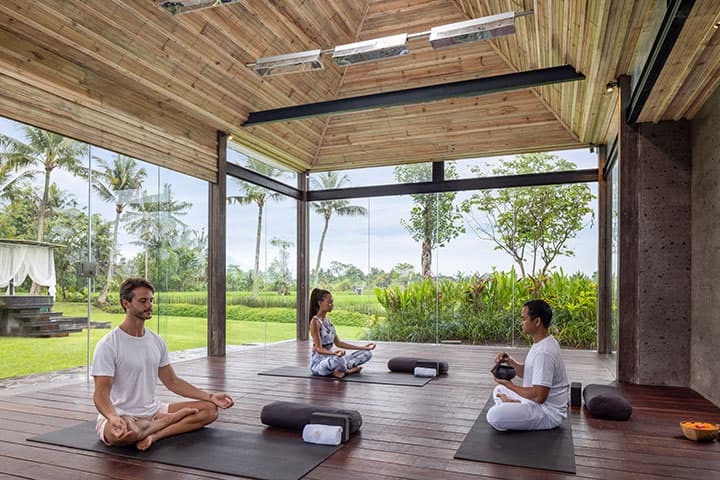

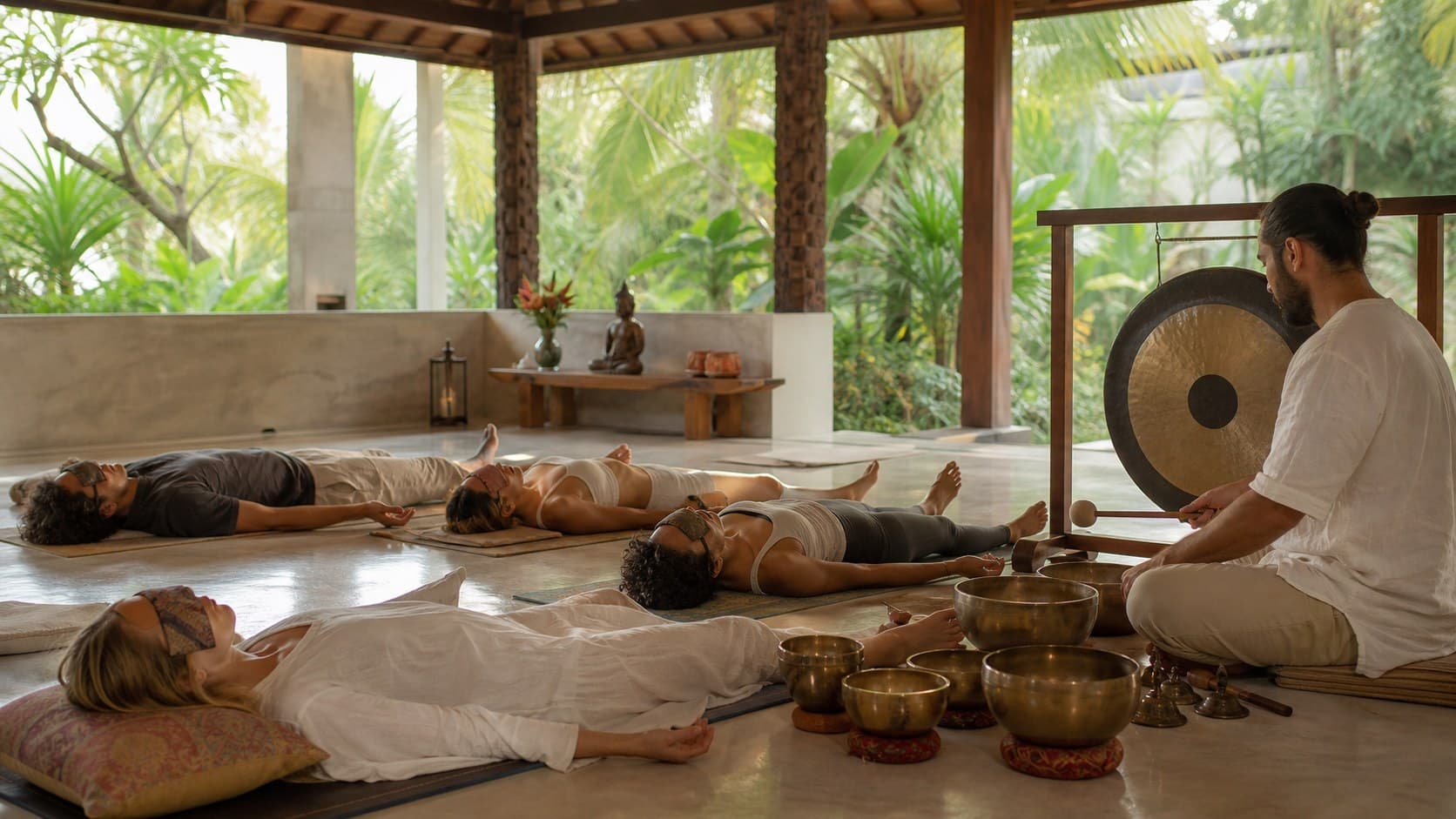
A sound healing retreat Bali experience combines guided listening and supported rest with a wider multi-day wellness programme. At YogaFX, singing-bowl sound healing and traditional Balinese ritual sit inside one structured six-day North Bali reset. It is not an isolated energy-healing treatment, silent retreat or sound-healing certification course.
The evidence boundary matters from the beginning.
Research specific to sound healing is still developing, and the locked research base for this retreat does not support claims that particular instruments or tones reset the brain, alter cells or treat illness.
Guests can value a calm, absorbing experience without being promised an unproven physiological result.
This article takes a critical middle ground.
Sound healing can offer a low-effort period of guided rest inside a full week.
It can be enjoyable, meaningful and easier to enter than a strenuous practice.
At the same time, those qualities do not turn it into medical care or prove a special sound mechanism.
The distinction is useful for guests comparing retreats.
An honest sound healing retreat should explain what actually happens, how the session fits the wider programme and what claims the provider will not make.
The experience should not depend on a guest believing a frequency story before they arrive.
Sound Healing and Spiritual Healing at the YogaFX North Bali Retreat
A Bali spiritual healing retreat can bring ritual, reflection, movement and restorative practice into one protected period away from ordinary pressure.
YogaFX combines these elements within a defined programme rather than asking guests to assemble unrelated ceremonies and sound sessions across the island.
Traditional Balinese Ceremony
The six-day arc includes a Welcome Puja, a Shamanic Fire Ceremony and a private session with a Traditional Healer.
These experiences are presented as cultural and reflective parts of the retreat. They are not medical treatment, psychotherapy or proof of a supernatural outcome.
Sound Healing Therapy
A Deep Cellular Sound Reset using singing bowls provides a low-demand period for listening and supported rest.
The programme uses the phrase sound healing in its familiar wellness sense. It does not claim that sound alters cells, cures disease or reliably releases trauma.
Yoga, Breath and Movement
Tai Chi, Somatic Decompression Yoga, Nervous System Reset Sessions and Integration Yoga Mobility add body awareness and gentle movement around the sound practice.
No advanced yoga, meditation or spiritual-retreat experience is required.
Nature and Cultural Immersion
Forest bathing, hot springs, a Buddhist temple visit and a sacred waterfall trek connect reflective practice with the North Bali landscape.
The retreat remains based at one private, alcohol-free sanctuary rather than moving guests through multiple tourist centres.
When It Runs
The confirmed intake runs from January 31 to February 4, 2027. It lasts six days and five nights and is capped at 20 guests.
Who This Spiritual Retreat Is For
The programme is designed for executives, founders and professionals who feel depleted by sustained work pressure or caught in coping loops involving alcohol, caffeine, scrolling or overwork.
Individuals can attend alone. Couples, business partners and close friends may also apply when they want to move through the same structured reset.
It is not designed as an open-ended search for psychic readings, astrology or unrelated energy sessions. The ceremonies and sound practice sit within a clear progression from grounding to integration.
Realistic Benefits of a Spiritual Retreat
A structured spiritual retreat can create time for reflection, cultural connection, shared attention and distance from habits that are difficult to notice at home.
Sound healing can offer a restful sensory focus. Ceremony may carry personal or cultural meaning. Movement and nature can help guests notice how they respond to effort and quiet.
These are realistic experiential benefits, not guaranteed clinical outcomes.
Sound Healing Retreat or Certification Course?
People searching for sound healing training Bali or sound healing certification Bali are looking for a different product.
| Question | YogaFX retreat | Professional training |
|---|---|---|
| Purpose | Receive a guided wellness experience | Learn to facilitate sound sessions |
| Curriculum | Sound is one part of a six-day reset | Instrument technique, safety, ethics and supervised practice |
| Assessment | No facilitator assessment | May assess knowledge and practical competence |
| Credential | No sound healing certificate | Credential depends on the issuing organisation |
YogaFX does not advertise this retreat as sound-healing teacher training or certification.
What Sound Healing Actually Involves
Sound healing generally involves resting while a facilitator creates an intentional sequence of audible tones.
Instruments may be visible, and the sound may vary in volume, texture and duration.
The practical activity for the guest is simple: settle comfortably, listen and notice the experience without needing to perform.
Simple does not mean identical for everyone.
One guest may find sustained sound absorbing.
Another may notice thoughts continuing in the background.
Someone may become sleepy, while someone else remains alert.
None of those responses is a correct result or evidence that the session has failed.
The term healing can cause confusion.
In this context, it names a familiar wellness practice.
It does not mean YogaFX claims to heal an injury, trauma, nervous system disorder or mental health condition.
A more precise description is guided sound relaxation.
During the session, guests are not required to meditate perfectly or clear the mind.
Attention naturally moves.
Sound can provide a shared point of focus without demanding a complex sequence or an intellectual task.
When attention wanders, the next audible change gives it somewhere to return.
The environment contributes as much as the sound.
A comfortable position, predictable guidance, time away from work, a calm group and the North Bali setting all shape the experience.
It would be misleading to attribute every sense of ease to an instrument while ignoring the conditions surrounding it.
This is why context is central to the YogaFX approach.
Sound healing is not sold as an isolated intervention.
It sits among movement, workshops, nature, meals, social contact and recovery.
The session creates a quieter interval inside that larger structure.
What the Research Does and Does Not Show
The current evidence does not justify strong sound-specific health claims.
The locked citation set for this programme contains no study showing that a YogaFX sound healing session produces a measurable clinical outcome.
That limitation belongs in the main explanation, not hidden in a disclaimer.
Sound healing marketing often moves quickly from a relaxing experience to an explanation involving exact frequencies or direct changes in the brain and body.
This article does not make that move.
YogaFX does not need a frequency claim to explain why a supported period of listening may be welcome during a demanding week.
A guest's report that a session felt calming is valid as a description of their experience.
It is not proof that the same response will occur for everyone or that a specific mechanism caused it.
Personal meaning and scientific evidence answer different questions, and responsible wellness writing keeps them separate.
Stephen Porges' 2022 review, Polyvagal Theory: A Science of Safety, discusses autonomic state, defensive responses, social engagement and cues of safety.
It supports a general point about regulation: context and trusted social connection can matter when people move from activation towards calmer states.
That framework does not demonstrate that a singing bowl activates a particular pathway or that sound resets the nervous system.
The connection must remain modest.
A guided group, predictable pacing and a setting perceived as safe may support relaxation.
Sound is one feature of that context, not a proven standalone treatment.
Evidence caution does not make the session pointless.
Many worthwhile retreat experiences are chosen because they create rest, pleasure, attention or connection.
The honest question is whether the description matches what is offered.
Here, the promise is a complementary relaxation practice inside a broader programme.
The standard should also apply after the session.
Feeling lighter, rested or emotionally moved can be meaningful.
It should not be translated into a diagnosis, a claim that trauma was released or a reason to stop medical or psychological care.
How Sound Healing Fits Into a Larger Nervous System Programme Here
Sound healing supports the programme's rhythm; it is not the programme's central mechanism.
YogaFX places it alongside the confirmed Somatic Decompression Yoga and Nervous System Reset (NS Reset) Sessions, which more directly organise attention around body state, movement and habitual effort.
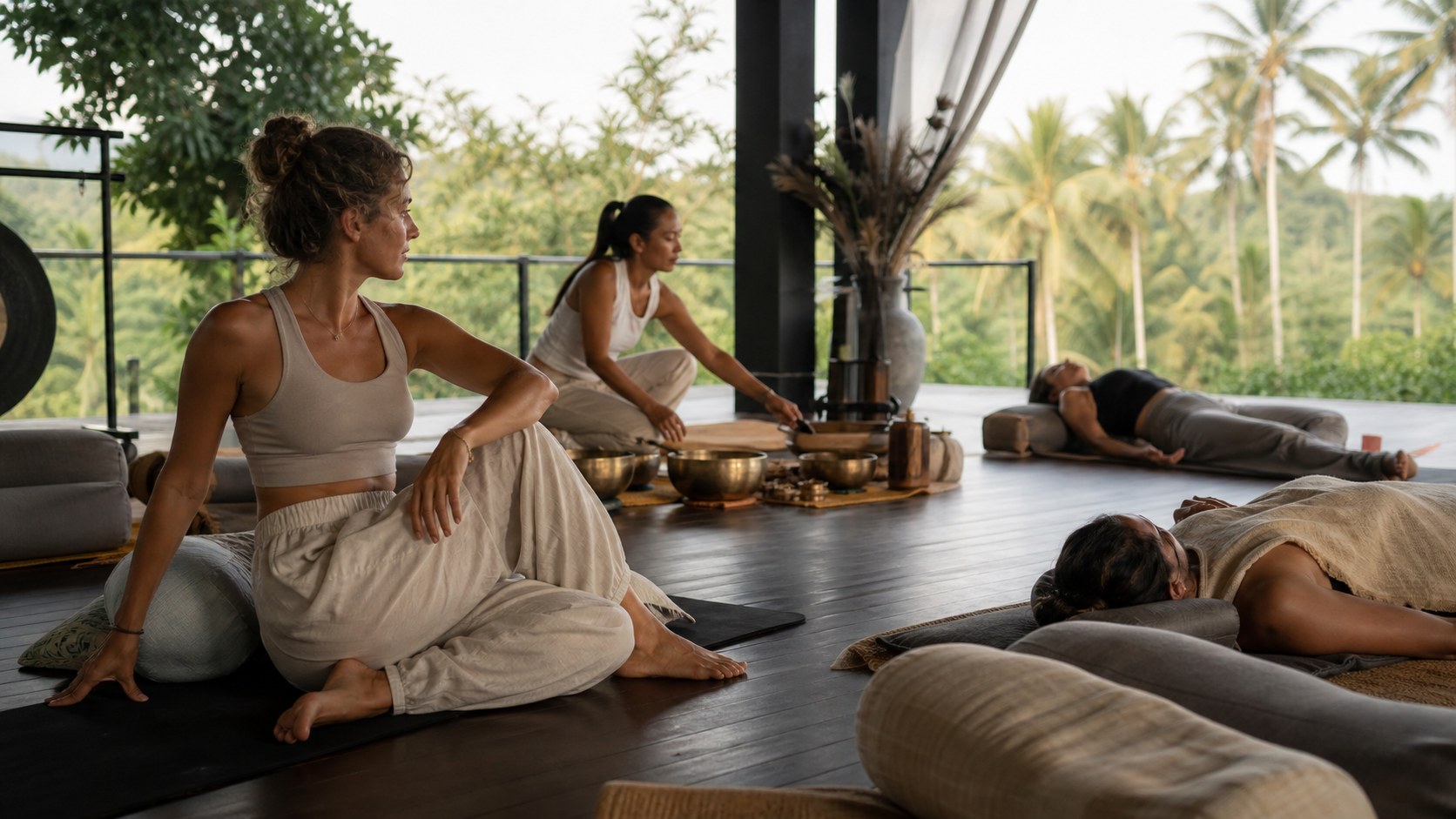
The distinction is described fully in the guide to the somatic retreat.
Somatic Decompression Yoga uses slower, body-aware movement.
NS Reset Sessions guide guests to notice state and adjust unnecessary activation.
Sound healing asks less of the body and creates a period in which listening and rest can take priority.
Those differences let the practices complement one another.
A guest who has spent a session noticing effort may find it useful to rest afterwards without another performance target.
Another guest may become more aware of physical comfort because the changing sound gives the mind a simple external reference.
Mr. Ian Terry leads the retreat personally and connects the sessions to the six-day progression.
The value of guidance is not a claim that he is providing sound therapy as clinical care.
It is that guests understand why the practice is present, how to participate and when to adjust or step out.
The wider programme also includes a digital detox retreat approach.
Reduced screen interruption can make sustained listening easier, but digital detox research does not prove a sound-specific outcome.
The two practices simply support a shared practical goal: giving attention fewer competing demands.
Movement, nature, nutrition, group connection and rest remain essential parts of the setting.
If a guest feels better after the week, it would be inaccurate to assign the whole change to one sound session.
The retreat is designed as a sequence, not a collection of isolated miracle tools.
This is the critical middle ground.
YogaFX includes sound healing because a non-strenuous, guided relaxation period can belong in a recovery programme.
It does not promote sound as the treatment that makes every other part work.
What to Expect During a Session
Guests can expect a calm group setting, a supported resting position and a facilitator-led progression of sound.
Exact instruments and session details should be confirmed by the retreat team rather than inferred from general sound-healing culture.
This article does not invent a fixed instrument list or ritual.
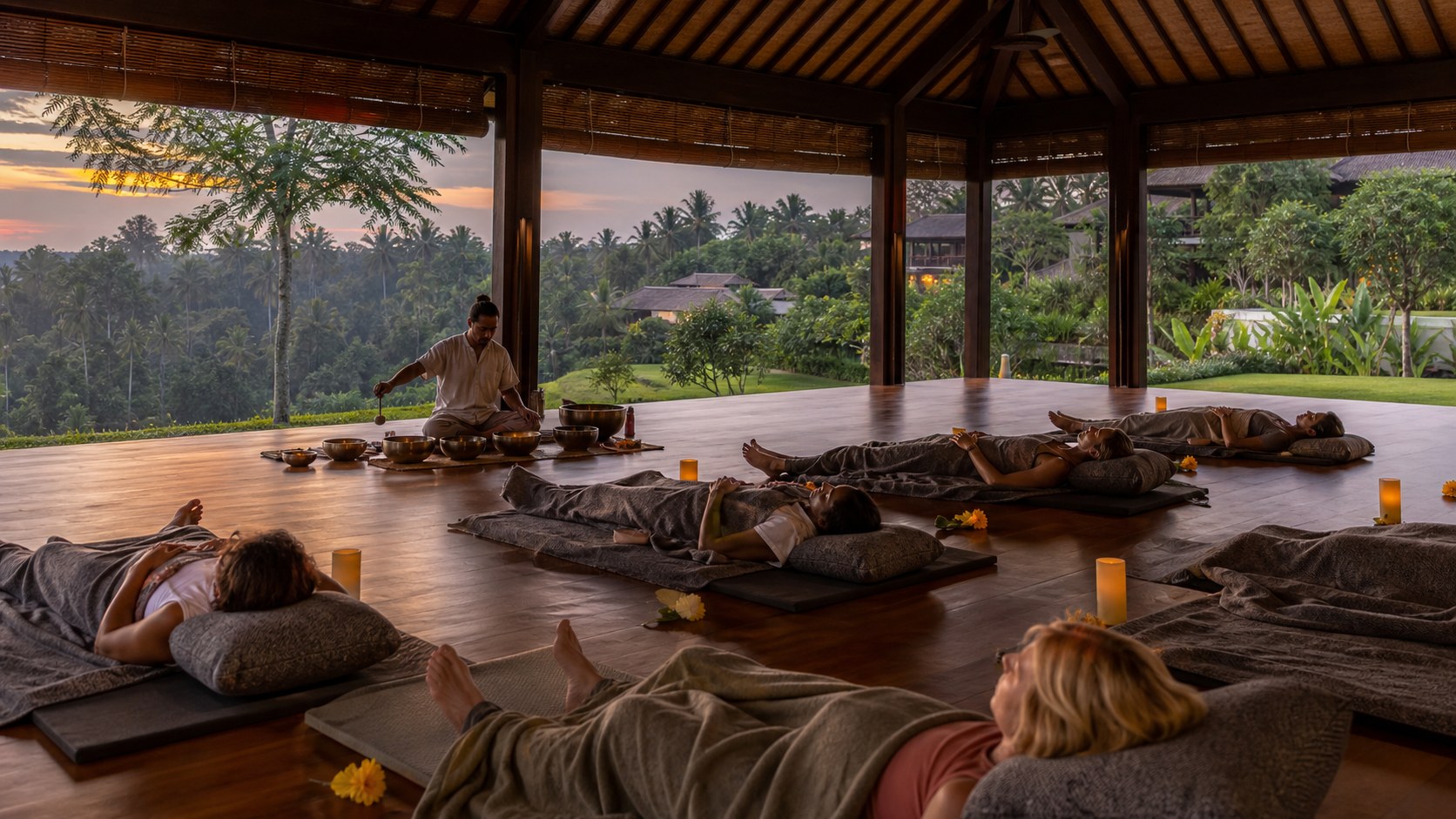
Before the session begins, guests settle on individual mats and use available support for comfort.
A person may prefer to lie down or choose another suitable resting position.
Comfort matters because pain or strain competes with the attention the session is designed to hold.
The facilitator introduces the session and begins the sound sequence.
Guests do not need to match a rhythm, visualise a result or understand the instruments.
They can listen to changes in tone, volume and space while allowing ordinary thoughts and sensations to come and go.
Resting in a group can feel different from resting alone.
The shared structure removes the need to decide what happens next.
It can also make stillness feel more permissible for people who usually treat every quiet interval as an opportunity to check work.
Not everyone enjoys every sound.
Guests should communicate if volume, vibration, position or another aspect creates discomfort.
Leaving, sitting up, changing position or using greater distance is an appropriate adjustment, not a failed response.
People with sound sensitivity, tinnitus, migraines, hearing concerns, a neurological condition or another relevant health circumstance should discuss participation in advance and seek individual clinical advice when appropriate.
A retreat description cannot determine personal safety.
Afterwards, the transition back to ordinary activity should remain unhurried.
Some guests may want to speak; others may prefer a quiet few minutes.
There is no requirement to report an insight, emotional release or altered state.
Rest itself is a sufficient reason for the session to exist.
Who May Appreciate Sound Healing Most
Sound healing may appeal to guests who want a low-barrier practice that does not depend on fitness, flexibility or prior meditation experience.
It offers a contrast to workshops and more active sessions without asking the guest to master another technique.
High achievers sometimes find passive rest surprisingly difficult.
A structured listening period gives rest a beginning, middle and end.
That structure can make it easier to remain present than an open instruction to relax for an hour.
Guests who feel mentally busy may appreciate having an external point of attention.
The goal is not to stop thought.
Listening simply offers another sensory channel to notice when the mind returns to planning, replaying or problem-solving.
The practice also has broad social accessibility.
Guests can share the same room while having different internal experiences.
Nobody needs to disclose personal material, perform for the group or believe the same explanation.
Sound healing may not suit everyone.
Some people find particular tones unpleasant or feel more alert rather than less.
A careful programme leaves room for those differences and does not pressure a guest to interpret discomfort as healing.
The World Health Organization classifies burnout in ICD-11 as an occupational phenomenon, not a medical condition.
A relaxation practice can form part of a broader recovery-oriented week for someone affected by chronic workplace stress, but it does not diagnose burnout or replace appropriate care.
How to Evaluate a Sound Healing Retreat Honestly
Look for a clear session description, realistic claims and a programme that does not depend on sound alone.
A provider should be able to explain whether sound healing is central or complementary, who guides it and what guests can do if they are uncomfortable.
Be cautious when exact tones are linked to guaranteed changes in organs, cells, trauma or disease without relevant evidence.
Impressive vocabulary is not the same as a supported mechanism.
A responsible retreat can describe the experience without turning metaphor into biology.
Check the rest of the week.
Sleep opportunity, food, movement, nature, social context and workload boundaries are more informative than a single dramatic session name.
At YogaFX, sound healing belongs to that larger design.
Finally, ask whether the approach leaves room for individual response.
A claim that every guest will enter the same state is neither realistic nor respectful.
A good session offers guidance, comfort and permission to adjust.
Pricing and How to Apply
Single occupancy is $3,799 USD, or $3,499 USD early bird.
Twin share is $2,799 USD per person, or $2,499 USD per person early bird.
A $500 USD deposit is requested after application acceptance, and four-installment plans are available.
The six-day retreat includes sound healing within a wider programme of somatic work, NS Reset Sessions, movement, nature, nutrition and integration.
A sound healing retreat does not need exaggerated science to offer a worthwhile experience.
YogaFX presents sound as a guided relaxation practice inside a fuller nervous system and burnout-recovery programme, with its benefits and limits stated plainly.
Register your interest to ask how the session fits the week.