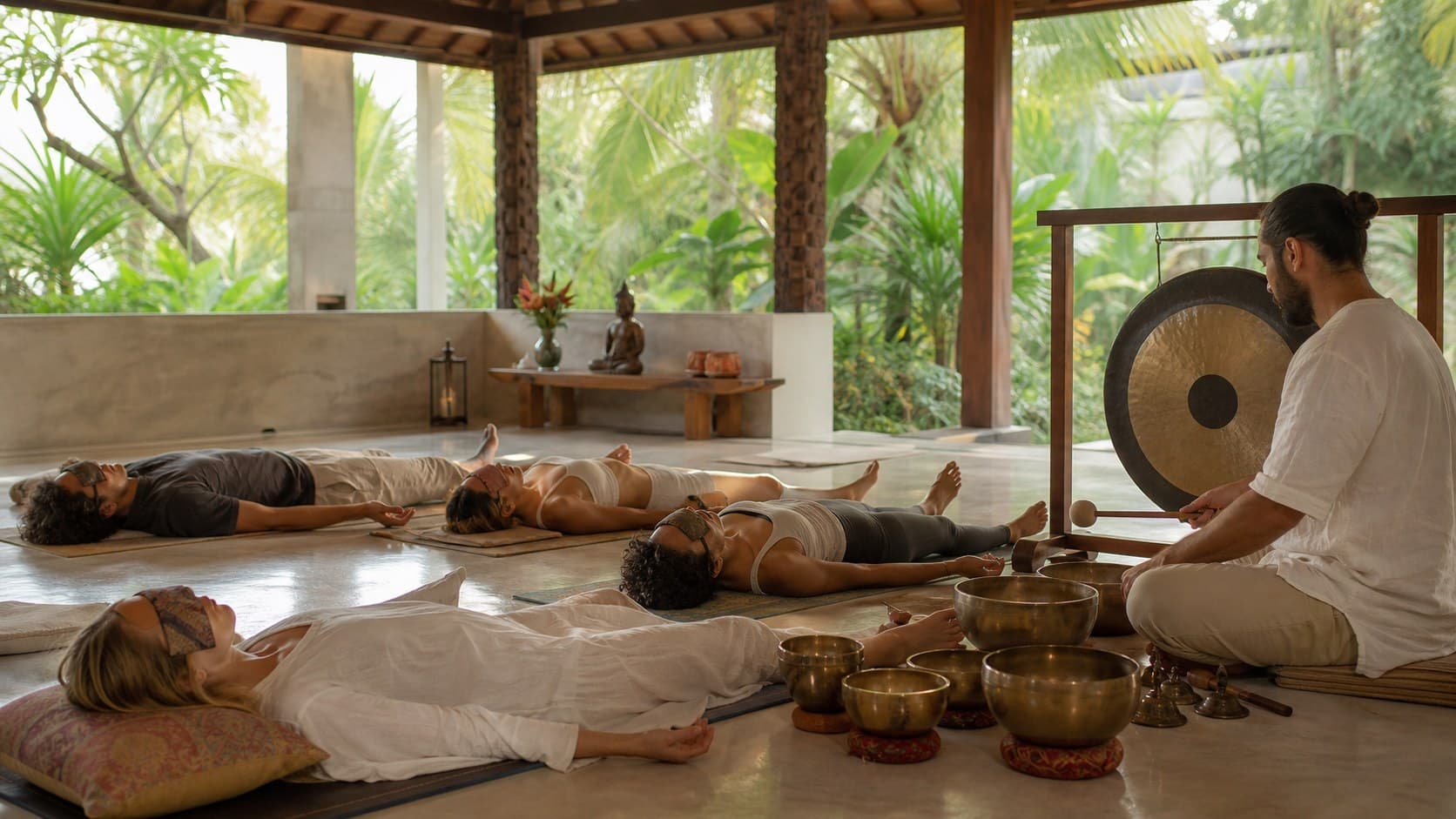


A somatic retreat is a guided programme that uses body-based awareness and movement to help guests notice how stress and tension are showing up physically.
It does not rely only on talking or analysing a problem.
The YogaFX Bali Detox & Burnout Retreat includes two confirmed somatic offerings.
They are Somatic Decompression Yoga and Nervous System Reset Sessions.
That definition needs a careful boundary.
Somatic wellness work can help a person pay attention to sensation, effort, posture, movement and shifts in state.
It is not trauma therapy, does not diagnose nervous system dysregulation and cannot promise to heal stored trauma.
YogaFX is a retreat provider, not a clinical trauma-treatment service.
For a burned-out executive or high achiever, the body-based emphasis can be useful because insight is often not the missing piece.
Many guests already know they are overworking.
They can explain the deadlines, the sleep debt and the coping habits in impressive detail.
What they may not notice is how constantly they brace, rush, override fatigue or treat stillness as wasted time.
A somatic retreat creates enough structure and distance for those patterns to become observable.
Instead of asking only, “What do I think about my stress?”, the guest also asks, “What happens in my body when I stop pushing?” That is a practical question, not a diagnosis.
What “Somatic” Actually Means: Body-Based, Not Just Talk-Based
Somatic means relating to the body as it is experienced from within.
In a wellness setting, that can include noticing pressure, temperature, muscle effort, balance, comfort, agitation or ease while moving or resting.
The purpose is not to produce a perfect interpretation of every sensation.
It is to become more accurate about what is happening now.
A cognitive approach often begins with language.
A person identifies a belief, tells a story, makes a plan or reframes an assumption.
Those tools can be valuable.
Somatic work adds information that words alone may miss.
Someone can say they feel calm while their jaw remains tight, their shoulders stay raised and every pause produces an urge to act.
This does not mean stress is literally stored in one muscle like a file in a drawer.
“Stored tension” is useful everyday language for recurring patterns of bracing, guarding and effort.
It should not be treated as a precise medical mechanism.
Bodies adapt to repeated demands, and people can become so familiar with that adaptation that it feels normal.
The body-based question is therefore concrete.
Can the guest notice unnecessary effort?
Can a movement become smaller without being abandoned?
Can rest be experienced without immediately converting it into another task?
Can discomfort be communicated before it becomes overwhelm?
Somatic work is also different from simply relaxing.
A guest may first notice more sensation, not less.
Slowing down can reveal fatigue that productivity had been masking.
That discovery can feel inconvenient, especially for someone whose identity is built around capability.
The value lies in meeting the information with curiosity rather than forcing a particular state.
The YogaFX programme keeps this approach inside a broader six-day arc.
Movement, group guidance, recovery, nature, nutrition and reflection support one another.
The somatic sessions are not presented as a standalone cure or an alternative to healthcare.
Somatic Decompression Yoga: What It Involves
Somatic Decompression Yoga is a confirmed YogaFX session built around slower, body-aware movement rather than performance.
The guest works close to the floor, follows guidance and pays attention to comfort, effort and change.
It is not a test of flexibility, strength or prior yoga knowledge.
The word decompression describes the intention, not a guaranteed physiological event.
High performers often approach movement with the same strategy they bring to work: more range, more effort, a better result.
This session asks for another kind of skill.
A smaller movement performed with clear attention may provide more useful information than a dramatic shape achieved by overriding sensation.
Research on clinical body-oriented methods gives context, but it must not be transferred directly to a retreat yoga session.
A 2021 scoping review by Kuhfuß and colleagues examined Somatic Experiencing, a specific body-oriented trauma therapy.
The review found preliminary evidence across varied studies while emphasising limitations in study quality and the need for stronger research.
A 2017 randomised controlled study by Brom and colleagues evaluated fifteen weekly Somatic Experiencing therapy sessions for people diagnosed with PTSD.
It reported promising clinical results and called for further research.
That intervention involved trained therapists, diagnosed participants and a treatment protocol.
Somatic Decompression Yoga is not Somatic Experiencing therapy and does not inherit its outcomes.
The research is useful for a narrower reason.
It shows why body-oriented attention is taken seriously rather than dismissed as vague wellness language.
It also demonstrates why scope matters.
A clinical therapy study supports investigation of clinical therapy.
A non-clinical retreat can responsibly offer guided body awareness without claiming to treat PTSD.
During Somatic Decompression Yoga, a guest may notice the difference between effort that supports a movement and effort that has become habitual.
They may discover that one side feels different from the other or that slowing down creates impatience.
The facilitator can invite observation and adjustment, but the guest remains the authority on pain, dizziness, overwhelm or the need to stop.
The session can be especially revealing after months of desk work, travel and continuous decision-making.
The aim is not to correct every posture in one class.
It is to interrupt automatic pushing long enough for a different response to become possible.
Nervous System Reset (NS Reset) Sessions
Nervous System Reset Sessions are the retreat's confirmed guided sessions for noticing state and practising a shift away from unnecessary activation.
The phrase reset is accessible wellness language.
It does not mean that the autonomic nervous system is rebooted like a computer or permanently returned to a default setting.

Mr. Ian Terry leads the retreat personally.
In an NS Reset Session, guidance and group context matter because people do not regulate in isolation from their environment.
Tone of voice, pacing, predictability and the presence of other people can influence whether an experience feels manageable.
Stephen Porges' 2022 review, Polyvagal Theory: A Science of Safety, describes a theoretical framework linking autonomic state, cues of safety, defensive responses and social engagement.
The framework proposes that trusted social connection can support co-regulation and access to calmer states.
Polyvagal Theory is influential and continues to be discussed and tested.
It should not be used as proof that a single retreat session repairs the vagus nerve, releases trauma or guarantees a particular mental health outcome.
YogaFX uses the framework conservatively: context, social connection and felt safety matter when asking a stressed person to slow down.
An NS Reset Session is not simply a conventional yoga class under a new name.
A standard class may organise attention around a posture sequence and its physical execution.
An NS Reset Session organises attention around current state, response and the possibility of adjusting effort.
Movement may be present, but achievement is not the organising goal.
The session also makes room for different responses.
One guest may settle quickly.
Another may feel restless when stimulation decreases.
Someone else may notice tiredness, emotion or difficulty concentrating.
None of those reactions proves a hidden diagnosis.
They are information to communicate and approach within an appropriate range.
The six-day setting helps because regulation is influenced by more than one session.
Sleep opportunity, meals, movement, social connection, nature and reduced digital interruption all shape the surrounding conditions.
The related digital detox guidance reduces one source of fragmented attention without pretending that a phone is the only cause of stress.
What a Somatic Retreat Is Not
A somatic retreat is not automatically trauma therapy, psychotherapy or medical treatment.
The word somatic describes a body-based orientation.
It does not tell you who is qualified, what protocol is used or whether a service is clinical.
Those questions must be answered separately.
YogaFX does not present Somatic Decompression Yoga or NS Reset Sessions as treatment for trauma, PTSD, depression, anxiety or another condition.
The sessions do not replace assessment by a qualified mental health professional.
A guest who needs trauma therapy deserves a provider trained and licensed for that work.
The retreat is also not an intensive exposure process.
Guests are not asked to retrieve traumatic memories, disclose private experiences to a group or push through overwhelm.
A wellness facilitator can offer options and encourage communication.
They should not turn distress into evidence that a breakthrough is occurring.
Nor is the programme a generic yoga holiday with nervous system language added for marketing.
The two named somatic offerings have a defined place within Somatic & Nervous System Restoration.
Their role is to help guests notice state and habitual effort inside a guided recovery programme.
Finally, a somatic retreat is not a promise to feel calm at all times.
Human nervous systems move through activation and settling in response to real circumstances.
The responsible aim is greater awareness and more options, not a permanently serene identity.
Who Benefits Most From This Approach
This approach is most relevant to a person who understands their stress intellectually but continues to live it physically.
That may be an executive who can describe burnout yet still holds every meeting in their shoulders, a founder who cannot rest without guilt or a caregiver who notices everyone else's needs before their own.

The World Health Organization includes burnout in ICD-11 as an occupational phenomenon resulting from chronic workplace stress that has not been successfully managed.
It is not classified there as a medical condition.
This context suits the retreat's scope: YogaFX supports recovery habits and awareness but does not diagnose or treat an illness.
A body-based approach may help someone recognise their early warning signs before exhaustion becomes the only signal they respect.
Tightness, shallow attention, irritability, restless movement and difficulty stopping can become prompts to check in rather than obstacles to override.
These observations remain personal and non-diagnostic.
Guests do not need previous yoga or somatic experience.
In fact, beginners may arrive with fewer expectations about performing correctly.
The important skills are communication, willingness to adjust and respect for personal limits.
Experience does not make someone immune to over-effort.
The approach may be unsuitable when a person is medically unstable, in acute psychological crisis or seeking treatment for unresolved trauma.
It may also need modification for pain, injury, pregnancy, mobility limitations or another health circumstance.
The application process is the place to disclose relevant concerns and ask what can realistically be supported.
For the right guest, somatic work complements other parts of the programme.
A biohacking retreat frame asks how changing inputs affects wellbeing.
A somatic frame asks how those changes are actually experienced in the body.
The two can overlap without turning the retreat into a clinic.
It also complements the broader burnout retreat conversation.
A person may leave with practical boundaries, a clearer relationship with devices and a better ability to notice when effort has become automatic.
No single session creates that integration.
The six-day sequence gives the observations somewhere to go.
From Retreat Insight to Daily Practice
The useful outcome is not dependence on a retreat setting but a more accurate response to ordinary stress.
A guest returns to email, decisions and relationships.
The question is whether they can recognise escalation earlier and choose a proportionate adjustment before the pattern becomes exhaustion.
That adjustment might be changing position during a long work block, stopping a movement that causes pain, protecting recovery time or noticing when urgency has spread beyond the genuinely urgent task.
These are modest choices.
Their value comes from repetition, not drama.
Somatic awareness should not become another surveillance project.
Constantly scanning for the perfect nervous system state can create more anxiety.
The retreat instead offers periods of guided attention, followed by activity, food, nature and social contact.
The body remains part of life rather than becoming a problem to optimise.
The same principle protects scientific honesty.
Research on Somatic Experiencing therapy cannot prove the effect of Somatic Decompression Yoga.
Polyvagal Theory cannot guarantee an NS Reset Session outcome.
These sources explain why body state, context and social safety deserve attention.
They do not license claims beyond the programme's non-clinical scope.
Apply for the YogaFX Bali Reset
The six-day YogaFX programme includes Somatic Decompression Yoga and Nervous System Reset Sessions.
It is a guided social retreat limited to 20 guests.
Use the application flow to discuss fit, relevant health considerations and what support the retreat can realistically provide.
A somatic retreat offers a body-based way to notice stress that intellectual understanding alone may not change.
YogaFX keeps that promise specific: Somatic Decompression Yoga, NS Reset Sessions, direct guidance and a six-day environment designed for recovery rather than performance.
Register your interest to ask whether the programme fits your circumstances.