


Yes, this can accurately be described as a biohacking retreat, provided biohacking means deliberately changing daily inputs to support attention, sleep, movement, recovery and behaviour.
The YogaFX programme is also a longevity retreat because it helps guests practise repeatable habits that can support a healthier life beyond six days.
It is not a medical clinic, a supplement protocol or a device-led optimisation camp.
It is a structured, nervous-system-first reset in North Bali.
Some guests arrive already using the language of biohacking.
Others simply say they feel depleted, distracted or unable to step out of patterns that no longer serve them.
Both groups are asking a similar question: can a carefully designed environment help the body and mind move away from constant pressure long enough to experience a different baseline?
The YogaFX answer is practical.
For six days, the programme changes the inputs that dominate ordinary working life.
Guests step away from repeated notifications, irregular meals, long periods of sitting, late nights and improvised coping.
Those inputs are replaced with guided movement, heat, hydrotherapy, anti-inflammatory meals, nature, somatic practice, reflection and human support.
The aim is not perfection.
The aim is to make recovery concrete enough to be felt, understood and repeated.
What "Biohacking" Actually Means and Why We Do Not Use the Word Lightly
YogaFX is not a device-heavy biohacking clinic.
The programme does not include blood panels, continuous biomarker testing or mandatory wearable tracking.
Guests seeking clinical diagnostics and quantified-self testing should choose a provider built for that purpose.
Biohacking is the deliberate adjustment of everyday inputs in order to influence how a person feels, functions or recovers.
The useful end of the category includes sleep routines, movement, food quality, light exposure, heat, cold, attention and behaviour.
The extreme end can become a collection of expensive devices, invasive measurements and unqualified promises.
The YogaFX retreat stays firmly with the useful, human-scale inputs.
The word matters because it can create expectations that a wellness programme cannot responsibly meet.
Six days cannot guarantee longer life, reverse disease or permanently reset human physiology.
No ethical retreat should promise those outcomes.
A structured week can, however, reduce ordinary distractions, provide repeated recovery practices and give guests direct experience of routines that are difficult to establish while work and home demands remain unchanged.
Burnout is also frequently folded into biohacking language without enough care.
The World Health Organization's ICD-11 guidance describes burnout through three dimensions: exhaustion, increased mental distance or cynicism related to work, and reduced professional efficacy.
WHO classifies burnout as an occupational phenomenon, not a medical condition.
That distinction supports a responsible middle ground.
A wellness retreat may support rest and healthier routines, but it does not diagnose or treat illness.
Mr. Ian Terry, CEO and Founder of YogaFX, designed the programme from over 12,000 teaching hours and training in applied neuroscience and brain health.
The programme sits between an unstructured spa holiday and a clinical intervention.
Every practice has a place in the sequence, and every claim has a boundary.
The Longevity Science Behind the 5 Pillars
A longevity retreat should improve the quality of the inputs guests can sustain, not promise a number of extra years.
YogaFX organises those inputs through five pillars: Reset Mentally, Detox Physically, Reboot Your Body, Nervous System Reset and Dismantle Self-Sabotage.
The pillars describe a practical sequence rather than five isolated treatments.
1. Reset Mentally
Mental reset begins by reducing the stream of digital demands that repeatedly pulls attention back toward work.
A 2025 preregistered randomised controlled trial published in PNAS Nexus blocked mobile internet access for two weeks and reported improvements in sustained attention, mental health and subjective wellbeing.
The study by Castelo and colleagues examined a longer intervention than this retreat, so it does not prove a six-day result.
It does show that changing digital access can produce measurable changes rather than merely creating a fashionable feeling of disconnection.
The retreat is not silent and guests are not punished for carrying a phone.
Digital detox is used as a protocol for protecting attention.
Emergency communication remains possible, while sessions, meals and recovery periods create practical boundaries around routine scrolling and workplace contact.
2. Detox Physically
Physical detox at YogaFX does not mean removing unnamed toxins or replacing medical care.
It means stepping away from alcohol, irregular eating, excessive stimulation and sedentary routines while supporting movement, hydration, sleep and nourishing food.
Heat-based practice is one component.
In a 2023 randomised controlled trial in The Journal of Clinical Psychiatry, 59.3% of participants assigned to heated yoga met the study's response criterion for reduced depressive symptoms.
Nyer and colleagues described the finding as preliminary and called for further research.
The trial supports careful interest in heated yoga, not a claim that heat detoxifies the body or treats depression in a retreat setting.
3. Reboot Your Body
Rebooting the body means rebuilding awareness and confidence through structured movement rather than pushing for peak performance.
A 2022 controlled pilot study in PLOS ONE explored Hatha yoga and body-awareness interventions among higher education teachers.
Rodríguez-Jiménez and colleagues reported encouraging changes related to stress, wellbeing and self-knowledge.
The sample was small, so the findings should not be treated as conclusive.
The study is useful because it examines body awareness as part of wellbeing rather than reducing yoga to flexibility or calorie expenditure.
Guests move through somatic yoga, mobility, walking and heat with adjustments for current capacity.
The objective is to notice signals earlier, understand the difference between productive effort and overload, and leave with a more useful relationship to movement.
4. Nervous System Reset
Nervous System Reset is wellness shorthand for supporting regulation.
A nervous system is not a machine that returns to factory settings.
Stephen Porges' 2022 Polyvagal Theory review describes how autonomic state and cues of safety relate to defensive reactions, social engagement and regulation.
Polyvagal Theory remains a theoretical framework.
It does not establish that one exercise or one retreat creates a permanent reset.
The wider evidence for body-oriented approaches also requires honest limits.
A 2021 scoping review by Kuhfuß and colleagues found promising results for Somatic Experiencing but emphasised limitations in study quality and the need for stronger research.
A 2017 randomised controlled trial by Brom and colleagues studied Somatic Experiencing for post-traumatic stress disorder.
Clinical trauma research offers related context for somatic practice, but it is not direct evidence that a wellness retreat treats trauma or psychiatric conditions.
5. Dismantle Self-Sabotage
Self-sabotage often looks less dramatic than the name suggests.
It can be the evening drink that has become automatic, the late-night work session that prevents sleep, the promise to exercise that disappears under pressure, or the impulse to reach for a phone whenever discomfort appears.
A retreat interrupts the setting in which those responses normally occur.
That interruption creates room to observe the sequence of cue, action and consequence.
The fifth pillar uses guided reflection, cognitive workshops and practical planning to turn insight into a next action.
The programme does not claim that six days erase long-established behaviour.
It gives guests time to identify a pattern, practise an alternative and decide how the alternative will be protected after returning home.
What Makes This a Longevity Retreat, Not Just a Wellness Holiday
A longevity retreat builds a coherent system around repeatable health-supportive behaviours.
A generic wellness holiday may offer a massage, a yoga class and healthy food without explaining how the pieces relate.
An extreme optimisation programme may make measurement itself the centre of the experience.
YogaFX occupies the critical middle ground: structured enough to have a rationale, human enough that the guest is not reduced to a dashboard.
The retreat schedule is an arc.
Early sessions focus on arrival, safety and reducing stimulation.
Middle days add heat, hydrotherapy, stronger movement and emotional reflection.
Later sessions shift toward integration and decisions about life after the retreat.
The order matters because intense effort on the first day would ignore travel fatigue, while deep reflection without adequate grounding can become another demanding task.
Physical inputs support that sequence.
Hot yoga, sauna, hydrotherapy circuits and cold water exposure are introduced as practices with real physiological demands, not as proof of superior willpower.
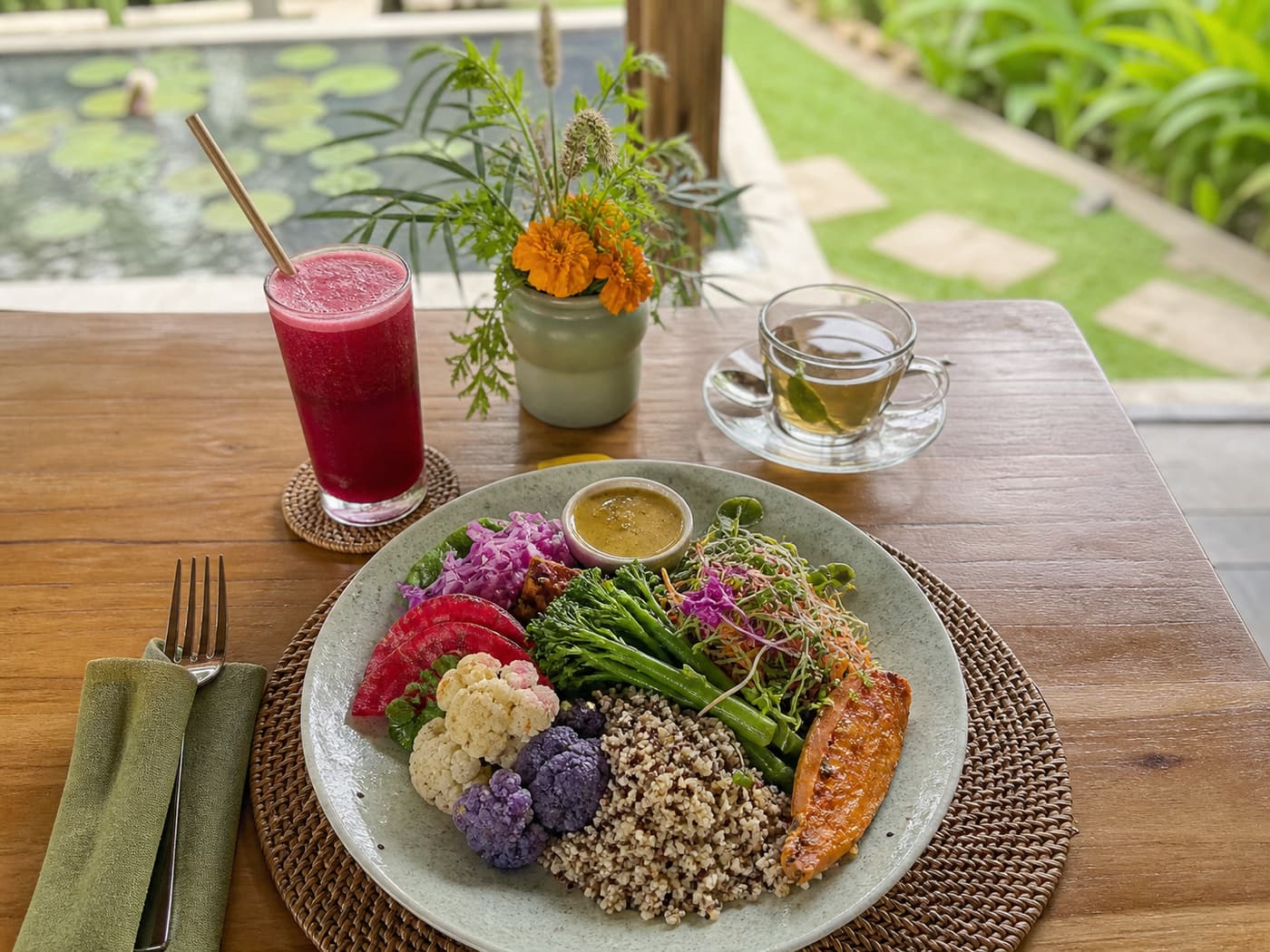
Cellular Cleanse Nutrition provides regular chef-prepared meals, cold-pressed juices and herbal drinks without extreme fasting.
Sleep and unstructured recovery time remain part of the programme rather than empty gaps to be filled.
The five-pillar methodology also includes explanation.
Guests are told why a practice appears where it does and how to recognise whether it is helping.
Understanding turns a memorable experience into a more portable one.
A guest who can describe the purpose of a phone-free meal or a recovery walk has a better chance of recreating the principle at home.
Who This Biohacking Retreat Is For
Burned-out executives and founders often arrive with strong professional capacity and weak recovery boundaries.
Work follows them into meals, evenings and sleep.
The retreat provides a fixed sequence that does not require them to design another project.
The goal is not greater output during the week.
The goal is to experience what clear attention and adequate recovery feel like again.
High-achievers caught in unhealthy coping loops may recognise dependence on caffeine, alcohol, scrolling, overwork or constant stimulation.
Those habits are not treated as moral failures.
They are responses that became automatic under pressure.
The programme changes the environment, reduces familiar cues and creates supported opportunities to practise different responses.
Our guide to the signs of burnout people often overlook offers a careful way to assess whether ordinary tiredness has become something more persistent.
Couples, business partners and close friends can attend when they want a structured reset together.
Shared experience can make change easier to discuss after returning home because both people understand the same practices and language.
Accommodation can be shared, while each guest still participates as an individual.
The retreat is not suitable for someone seeking medical diagnosis, intensive psychiatric care, emergency treatment or guaranteed physical transformation.
It is designed for adults who can participate safely in a wellness setting and who are willing to step away from normal routines.
The detox retreat Bali guide explains the questions every guest should ask before making that decision.
A Day Inside the Reset: Emotional Release and Hydrotherapy
Day 3 makes the programme concrete.
Guests have moved beyond arrival but have not yet reached the final integration phase.
The day begins without an alarm from a workplace message.
The estate is quieter than an ordinary morning at home, and breakfast follows the first guided practice rather than an inbox.
Movement prepares the body without turning the session into a test.
Mr. Ian can see how each guest has responded to the previous two days and adjust the intensity.
A guest who slept poorly may need less heat and more recovery.
A guest holding back through uncertainty may be ready for a clearer challenge.
The small group makes those distinctions possible.
The hydrotherapy circuit then changes temperature, sensation and attention.
Warmth encourages muscles to soften.
Cold water demands a clear relationship with breath.
Rest between exposures matters as much as the exposure itself.
Nobody earns status for staying longest, and discomfort is not treated as proof that a practice works.
The guest remains responsible for communicating limits.
After food and rest, guided reflection shifts attention toward the patterns underneath exhaustion.
The session does not force disclosure.
Guests can write privately, speak when useful and notice the difference between an emotion and an instruction.
Evening integration is intentionally quieter.
The objective is not to manufacture a breakthrough for the schedule.
It is to let a full day settle.

Nature immersion later in the week carries the same principle into a different environment.
Walking toward water asks for attention without requiring analysis.
A trail has immediate feedback: footing, temperature, sound, distance and breath.
The experience is simple, but simplicity is part of the intervention for people whose ordinary days are dominated by abstraction and screens.
Why Digital Detox Is a Protocol, Not a Silent Retreat Rule
Digital detox at YogaFX protects attention without requiring silence.
Guests talk, ask questions, share meals and build relationships.
Phones are reduced because mobile access can keep the nervous system and attention tied to responsibilities outside the estate.
Silence is not the goal.
More deliberate contact is the goal.
The distinction is important for guests who need to remain reachable in an emergency or who feel anxious about disappearing completely.
Boundaries can be clear without being punitive.
Phones can stay away during practice, meals, hydrotherapy and workshops, while a practical contact route remains available.
Reducing access for defined periods is easier to understand and repeat than a vague instruction to use technology less.
The digital detox also shows how this retreat approaches biohacking.
There is no need to buy another device to improve attention.
Sometimes the most useful adjustment is removing an input that fragments it.
The practice is low-tech, but the reasoning is specific.
From Six Days to a Repeatable Longevity Practice
The value of a retreat is tested after departure.
A beautiful week that cannot influence ordinary life remains a holiday, even when it contains excellent treatments.
Integration asks guests to choose a small number of practices that can survive travel, meetings, family demands and imperfect motivation.
A repeatable plan might protect one phone-free meal, establish a consistent evening boundary, schedule two movement sessions, reduce alcohol or use a brief breathing practice before a difficult conversation.
The exact choices differ because guests return to different lives.
The common requirement is realism.
A plan that depends on recreating a private Bali estate every morning is not a plan.
YogaFX therefore treats explanation and reflection as part of the longevity layer.
Heat, food, nature and movement provide the experience.
Integration translates experience into choices.
The result is not a permanent reset.
It is a clearer understanding of which inputs help, which patterns drain capacity, and which next actions deserve protection.
If this neuroscience-informed version of a biohacking retreat matches what you need, you can apply for the Retreat with a USD 500 deposit.
Payment plans are available during enrolment.
The January 31 to February 4, 2027 intake is limited to 20 guests so Mr. Ian can lead the programme personally and respond to the group.