

What is biohacking for women?
The phrase commonly describes changing and tracking everyday inputs such as sleep, movement, food, stress and attention in an attempt to feel or function better.
For a woman already exhausted by work and self-management, however, another system to monitor can become another source of pressure.
A structured retreat works differently because the schedule, environment and support are provided.
The guest does not have to turn recovery into another solo performance project.
This distinction matters.
Online conversations about biohacking for women often assume that more information creates more control.
A person can record sleep, score habits, catalogue symptoms and plan increasingly precise routines.
Data can be useful in an appropriate context, but collecting it does not automatically create rest, safety or sustainable behaviour.
An exhausted professional may understand every item on a recovery checklist and still feel unable to carry it out.
The YogaFX retreat does not offer hormone testing, supplement protocols, peptide advice or a women-only optimisation track.
It offers a six-day guided reset for suitable adults of different genders.
This article answers a question women are actively asking, while keeping the programme honest about what it is: a non-clinical wellness retreat built around nervous system regulation practices, movement, heat, hydrotherapy, nutrition, digital rest, nature and integration.
What "Biohacking for Women" Usually Means Online
Biohacking for women usually appears online as a self-directed optimisation system.
The individual is encouraged to collect more information, notice patterns and adjust routines.
Sleep, food, training, stress and attention may all become variables.
The language often suggests that the right combination will unlock a more productive, energetic or controlled version of the self.
There is an understandable appeal in that promise.
Many women in demanding professional roles have learned to solve problems by researching, planning and working harder.
When energy falls or sleep becomes unreliable, the familiar response is to build a better system.
A new spreadsheet, routine or measurement can feel more manageable than admitting that the existing pace may be unsustainable.
The difficulty is not that observation is always harmful.
The difficulty is that self-observation can become another job.
Every meal becomes a decision.
Every poor night becomes a score.
Every skipped practice becomes evidence of failure.
Recovery begins to carry the same pressure, comparison and urgency that contributed to exhaustion in the first place.
A careful answer to what is biohacking for women must therefore include context.
A practice that feels clarifying to a rested person may feel burdensome to someone already operating at the edge of capacity.
The relevant question is not only whether a method can produce information.
It is whether the person has enough time, support and flexibility to use that information without turning it into more pressure.
This article does not give hormone, supplement, cycle-syncing or biomarker advice.
Those topics require appropriate medical context and evidence that falls outside the approved source set for this site.
The focus here is narrower and more useful for the YogaFX guest: why guided structure may help when solo optimisation has become one more demand.
Why Solo Optimization Can Backfire During Burnout
Solo optimisation can backfire during burnout when it increases decisions, monitoring and self-judgment.
Burnout is not simply a shortage of good advice.
The World Health Organization's ICD-11 guidance describes burnout through exhaustion, increased mental distance or cynicism related to work, and reduced professional efficacy.
WHO classifies it as an occupational phenomenon rather than a medical condition.
That classification does not mean every exhausted person has burnout.
It does show why adding another performance system can miss the problem.
A professional who is already depleted may respond to reduced efficacy by measuring more, working longer and making recovery conditional on completing another list.
The method intended to help can begin to resemble the work pattern it was supposed to interrupt.
Nervous system language also needs careful boundaries.
Stephen Porges' 2022 Polyvagal Theory review discusses autonomic state, defensive reactions, cues of safety and social engagement.
Polyvagal Theory is a theoretical framework.
It does not prove that a retreat, breathing exercise or environment can permanently reset the nervous system.
The framework is still useful for understanding why context matters.
A person does not respond only to instructions.
The body also responds to the setting, pace, relationships and perceived demands surrounding those instructions.
Telling an exhausted person to relax while leaving every source of interruption in place can create a contradiction.
A quieter environment with clear expectations and supportive human contact may make restorative practices easier to approach, although individual responses vary.
Research into body-oriented approaches offers related context but requires similar caution.
A 2021 scoping review by Kuhfuß and colleagues described promising findings for Somatic Experiencing while highlighting limitations in study quality and the need for stronger research.
A 2017 randomised controlled trial by Brom and colleagues studied Somatic Experiencing for post-traumatic stress disorder.
Clinical trauma studies do not prove that a wellness retreat treats trauma, burnout or psychiatric illness.
They provide context for why body awareness and guided somatic work are studied at all.
The practical implication is modest.
Recovery may be easier to practise when a guest does not have to design every hour, defend every boundary and interpret every sensation alone.
That statement is not a hormone claim or medical promise.
It is a design principle for reducing unnecessary demands during a short wellness programme.
The Structured Alternative: What a Guided Reset Does Differently
A guided reset removes part of the planning burden and replaces isolated experiments with a coherent sequence.
Guests know when movement begins, when meals are served, when phones are put away and when rest is protected.
The structure is not meant to control every choice.
It creates enough predictability that the guest can participate without building the programme from scratch.
The first difference is environmental.
Workplaces, commutes, household routines and familiar coping cues are temporarily absent.
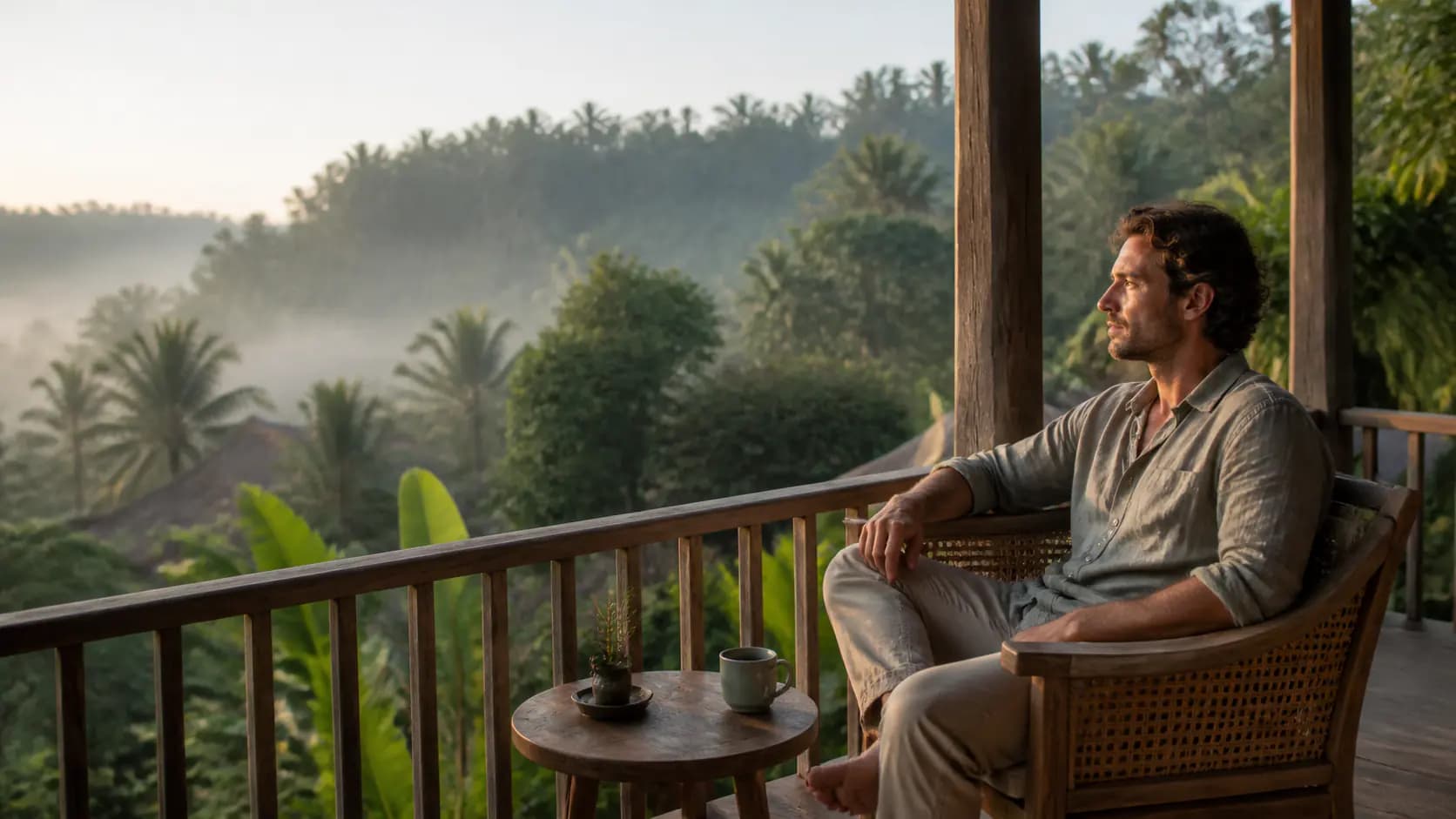
The North Bali setting does not magically regulate a nervous system, but it changes the ordinary inputs surrounding practice.
Nature, distance from crowded tourist areas and a small group reduce some of the interruptions that make attention difficult to protect at home.
The second difference is sequencing.
YogaFX does not present a menu of unrelated treatments.
The five pillars move from mental reset and physical detox toward body awareness, nervous system regulation practices and the examination of self-sabotaging habits.
Early sessions account for travel and uncertainty.
Middle days add heat, hydrotherapy and deeper reflection.
Later sessions focus on integration.
Digital detox is one example.
A 2025 preregistered randomised controlled trial published in PNAS Nexus blocked mobile internet access for two weeks and reported improvements in sustained attention, mental health and subjective wellbeing.
Castelo and colleagues studied a longer intervention than this retreat, so the result cannot be transferred directly to a six-day programme.
The research does support a careful rationale for reducing mobile access rather than treating phone-free periods as decoration.
The retreat is not silent.
Guests communicate, ask questions, share meals and form relationships.
Phones are reduced during practices and recovery periods because alerts can repeatedly pull attention toward responsibilities outside the estate.
Emergency communication remains possible.
The boundary is practical rather than punitive.

The third difference is guidance.
Mr. Ian Terry leads the retreat personally and can adjust a practice according to his observations and guest feedback.
A poor night of sleep may call for less intensity.
Uncertainty may call for clearer explanation.
Small-group delivery allows the sequence to remain structured without pretending that every person needs the same dose.
The fourth difference is integration.
A self-directed biohacking plan can produce many observations without helping a person decide what belongs in ordinary life.
Workshops and reflection ask guests to identify a small number of useful practices, barriers and next actions.
The plan must survive meetings, family responsibilities and imperfect motivation.
If it only works in a Bali sanctuary, it has not yet become a sustainable practice.
For a broader explanation of how the five pillars map onto longevity language, see our biohacking retreat guide.
For the programme's boundaries around food, heat and detox claims, the detox retreat Bali guide explains what a responsible operator should and should not promise.
How a Guided Day Reduces Decision Load
A guided day can support recovery by making fewer ordinary decisions necessary.
The guest does not begin by deciding which practice to stream, how long to exercise, what to prepare for breakfast or whether an email deserves an immediate response.
The programme has already created a direction.
Morning begins with a scheduled practice and a clear explanation of its purpose.
Movement is approached as information and participation rather than a test.
The teacher can offer variations, while the guest remains responsible for communicating pain, dizziness, fatigue or concern.
Breakfast follows at a known time with chef-prepared food, so nourishment is not another improvised choice.
Later sessions may combine somatic work, heat or hydrotherapy with defined recovery periods.
Rest is not treated as a reward for exceptional effort.
The schedule protects it because accumulated activity without recovery would reproduce the pattern many guests are trying to examine.
Reflection has boundaries as well.
A guest may write privately, contribute to a discussion or simply listen.
The programme does not require public disclosure and does not manufacture emotional intensity for effect.
The objective is to notice patterns without turning every feeling into a problem to solve immediately.
Evening becomes a transition rather than a second working day.
A phone-free meal, quiet conversation and a predictable stopping point can demonstrate how much stimulation an ordinary evening contains.
The insight is experiential.
Guests do not need a dashboard to recognise the difference between a settled night and one divided by repeated alerts.
Who This Approach Fits
This approach fits professionals who have enough information but not enough protected space to act on it.
A corporate executive may know that sleep, movement and boundaries matter while still carrying work into every evening.
A guided retreat removes the requirement to negotiate those boundaries hour by hour.
High-achievers caught in unhealthy coping loops may also recognise the pattern.
Caffeine supports the morning, scrolling postpones sleep, alcohol marks the end of work and overwork temporarily quiets uncertainty.
The programme does not frame those behaviours as personal defects.
It changes the context long enough for guests to observe cues, consequences and possible alternatives.
Our guide to the signs of burnout people may be ignoring provides a careful starting point without attempting diagnosis.
The retreat also fits couples, business partners and close friends who want to reset together.
Shared attendance can create common language around boundaries, rest and behaviour after the retreat.
Each guest participates as an individual, but neither person has to explain the entire experience from the beginning when they return home.

This is not a women-only retreat.
The article addresses the search question what is biohacking for women because many women encounter optimisation advice that adds more tracking to already demanding lives.
The actual YogaFX programme welcomes suitable adult guests across its established audiences, regardless of gender.
The approach does not fit someone seeking hormone testing, medical supervision, acute psychiatric support or a guaranteed physiological outcome.
Guests need to be able to participate safely in a wellness environment.
Medical, mobility, dietary and mental health considerations should be discussed before applying, with advice from an appropriate healthcare professional where needed.
Biohacking Without Turning Recovery Into Another Performance
The most useful biohacking question may be which demands can be removed.
Improvement does not always require another product, measurement or rule.
For an overloaded person, fewer inputs and clearer boundaries can be more workable than a more sophisticated tracking system.
That principle changes the definition of progress.
A successful day is not one in which every metric improves.
It may be a day in which a guest notices fatigue before pushing through it, eats without a screen, asks for an adjustment, rests without negotiating with guilt or has a difficult conversation without immediately escaping into work.
The retreat provides repeated opportunities to practise those choices.
Repetition matters because insight during one workshop can disappear when the familiar cue returns.
A phone-free meal happens more than once.
Movement is followed by recovery more than once.
Reflection is connected to an action more than once.
The week creates a small pattern rather than a single dramatic moment.
Integration then reduces the pattern to a realistic home plan.
A guest might protect one evening boundary, schedule two movement sessions, reduce alcohol, keep the phone away from one daily meal or use a brief grounding practice before opening email.
The plan is deliberately smaller than the retreat schedule.
Sustainability requires selection.
Answering what is biohacking for women responsibly means resisting the suggestion that women need another universal formula.
The YogaFX alternative is guided, contextual and non-clinical.
It offers a structure in which a guest can notice what supports recovery without being asked to become her own full-time experiment.
If that approach matches what you need, you can apply for the Retreat with a USD 500 deposit.
Payment plans are available during enrolment.
The January 31 to February 4, 2027 intake is limited to 20 guests, allowing Mr. Ian to lead the programme personally and respond to the group.