

"Nervous system reset" appears everywhere in wellness language.
It can describe breathing exercises, cold water, yoga, a weekend away, or almost any activity that feels calming.
Used that loosely, the phrase stops explaining anything.
A nervous system is not a device with a reset button.
There is, however, a serious body of research on autonomic regulation, stress, safety, somatic therapy, heat exposure, and movement.
This explainer separates that research from the marketing shorthand.
It looks at what the evidence supports, where it remains limited, and what the phrase can responsibly mean within a structured wellness programme.
What Nervous System Means Here
The nervous system includes the brain, spinal cord, and networks of nerves throughout the body.
In wellness discussions about stress regulation, people are usually referring more specifically to the autonomic nervous system.
It helps regulate functions that occur largely outside deliberate control, including heart rate, digestion, respiration, and physiological responses to challenge.
The autonomic nervous system is often described through sympathetic and parasympathetic activity.
Fight-or-flight is associated with sympathetic mobilisation, while parasympathetic pathways contribute to functions associated with rest, digestion, and recovery.
That simplified contrast is useful, but the biology is more complex than one branch being bad and the other good.
Stephen Porges' 2022 review, Polyvagal Theory: A Science of Safety, presents autonomic state as important to experiences of safety, threat, social engagement, and co-regulation.
The paper describes cues of safety as relevant to downregulating defensive reactions and supporting calmer, socially accessible states.
Polyvagal Theory is a theoretical framework.
It should not be presented as proof that one exercise, treatment, or Retreat can permanently reset the nervous system.
It offers a way to think about body state and safety, not a licence for guaranteed wellness claims.
Regulation Is a Better Word Than Reset
The word reset suggests that the nervous system begins in a faulty state, receives an intervention, and returns to a fixed factory setting.
Human physiology does not work like that.
Autonomic state continually changes in response to internal signals, environment, activity, relationships, memory, illness, and many other factors.
Regulation describes an ongoing capacity.
It means being able to respond to demand and then move toward recovery when the demand passes.
Sympathetic activation is useful when action is required.
The concern is not activation itself, but a pattern in which mobilisation, vigilance, or exhaustion feels difficult to leave.
Porges argues that removing an external threat does not automatically create an internal feeling of safety.
Within his framework, cues of safety and supportive social engagement can help downregulate defensive states.
This is one reason a physically comfortable holiday may not immediately produce the internal shift a depleted person expects.
Why Safety and Co-Regulation Enter the Conversation
Porges' framework places social engagement alongside autonomic state.
Facial expression, tone of voice, gesture, and the presence of trusted people can function as cues of safety.
In the theory, those cues help explain why regulation is not always a solitary act of willpower.
Calm is not simply a thought you command.
A person can understand intellectually that a room is safe while their body remains mobilised.
Polyvagal Theory proposes both top-down and bottom-up pathways, meaning cognition can influence body state while body state can also shape thought, feeling, and social accessibility.
This does not mean every friendly group automatically regulates every participant.
People interpret environments differently, and safety cannot be imposed.
It means programme details such as predictable pacing, consent, clear communication, and non-competitive instruction are relevant rather than decorative.
Co-regulation also helps explain why guided group practice can feel different from following instructions alone.
The evidence does not establish that a Retreat group provides therapy.
The narrower claim is that Porges' science-of-safety framework treats trusted social connection as relevant to autonomic regulation.
Chronic Stress and the Limits of Passive Rest
Time away from work can remove emails, meetings, deadlines, and commuting.
That can be valuable.
It does not guarantee that sleep, attention, muscle tension, emotional engagement, or habitual coping patterns change at the same speed.
The body may remain prepared for demands that are temporarily absent.
The WHO defines burnout as an occupational phenomenon resulting from chronic workplace stress that has not been successfully managed.
Its description includes exhaustion, increased mental distance or cynicism toward work, and reduced professional efficacy.
The WHO classification also states clearly that burnout is not classified as a medical condition.
Rest and structural change solve different problems.
Rest may reduce immediate load.
It does not automatically alter workload, workplace conflict, unclear expectations, or constant availability.
Recovery practices should not be used to make harmful conditions appear sustainable.
This also explains why one relaxing treatment can feel good without changing a longer pattern.
A useful experience is not dishonest simply because its effect is temporary.
The overclaim begins when temporary relief is marketed as a permanent physiological correction.
Why Body-Based Approaches Are Studied
Body-oriented approaches direct attention toward sensation, posture, movement, breathing, and the relationship between physiological experience and emotion.
Somatic Experiencing is one established therapeutic approach in this category, developed specifically in relation to traumatic stress.
A 2017 randomised controlled study by Brom and colleagues evaluated Somatic Experiencing for PTSD.
The study included 63 participants and compared 15 weekly sessions with a waitlist condition.
It reported reductions in post-traumatic symptoms and depression, while stating that more research was needed to understand who benefits most.
A 2021 scoping review by Kuhfuß and colleagues mapped the available Somatic Experiencing literature.
The review found promising findings but also limitations in the evidence base, including the need for more high-quality research.
These studies do not test a 6-day wellness Retreat.
They concern a therapeutic modality, often with trauma-related populations and repeated sessions.
They support interest in body-oriented work; they do not prove that every practice called somatic has the same effect.

What Grounding Looks Like Without the Marketing
Grounding practices often use simple, observable tasks: noticing contact between feet and floor, orienting toward the surrounding environment, tracking breathing without forcing it, or moving slowly enough to notice changes in sensation.
The goal is not to perform a difficult pose.
Within a wellness setting, these practices may create an opportunity to notice body state and reduce the speed at which attention moves.
Opportunity is the honest word.
A facilitator can provide structure and cues, but cannot promise the same response for every participant.
People with a trauma history or a diagnosed mental health condition may need appropriately qualified clinical support.
A Retreat facilitator and a licensed trauma therapist do not serve the same role.
Body awareness can be helpful for some people and uncomfortable for others, which is why consent, pacing, and alternatives matter.
Where Heat Therapy Fits
Heat exposure changes circulation and cardiovascular demand while the exposure is taking place.
A 2018 review in Mayo Clinic Proceedings summarised observational, experimental, and interventional evidence on Finnish sauna bathing.
It discussed associations with cardiovascular outcomes and possible mechanisms, while also highlighting uncertainty and the need for more long-term randomised studies.
That review focused heavily on Finnish sauna practices.
Its findings should not be treated as proof that every hot room, steam treatment, or temperature protocol produces identical results.
Heat dose, setting, and participant health matter.
A separate 2023 randomised controlled trial led by Nyer studied heated Hatha yoga in adults with moderate-to-severe depression.
Participants attended an average of 10.3 classes over 8 weeks.
The heated yoga group showed a greater reduction in depression symptoms than a waitlist control, and the authors described the results as preliminary evidence that warrants further research with active controls.
See the PubMed record.
The study was not a nervous system reset trial.
It examined heated yoga for depression over 8 weeks, not one sauna session and not a 6-day Retreat.
It supports careful inclusion of heated practice within a broader programme, but not claims of instant or permanent regulation.
Heat Is a Stressor, Not Automatic Relaxation
Heat can feel relaxing after exposure, but the exposure itself creates physiological demand.
That is why screening, hydration, duration, temperature, recovery, and individual tolerance matter.
More intense is not automatically more effective.
People with medical conditions, pregnancy, medication considerations, heat intolerance, or uncertainty about safe participation should consult a healthcare professional.
Evidence-informed use includes knowing when not to use heat.
In a structured programme, heat belongs within a sequence.
It should be balanced with hydration, rest, nourishment, and observation rather than treated as a challenge to endure.
The research supports caution and context more strongly than competitive heat exposure.

What This Looks Like in the YogaFX Retreat
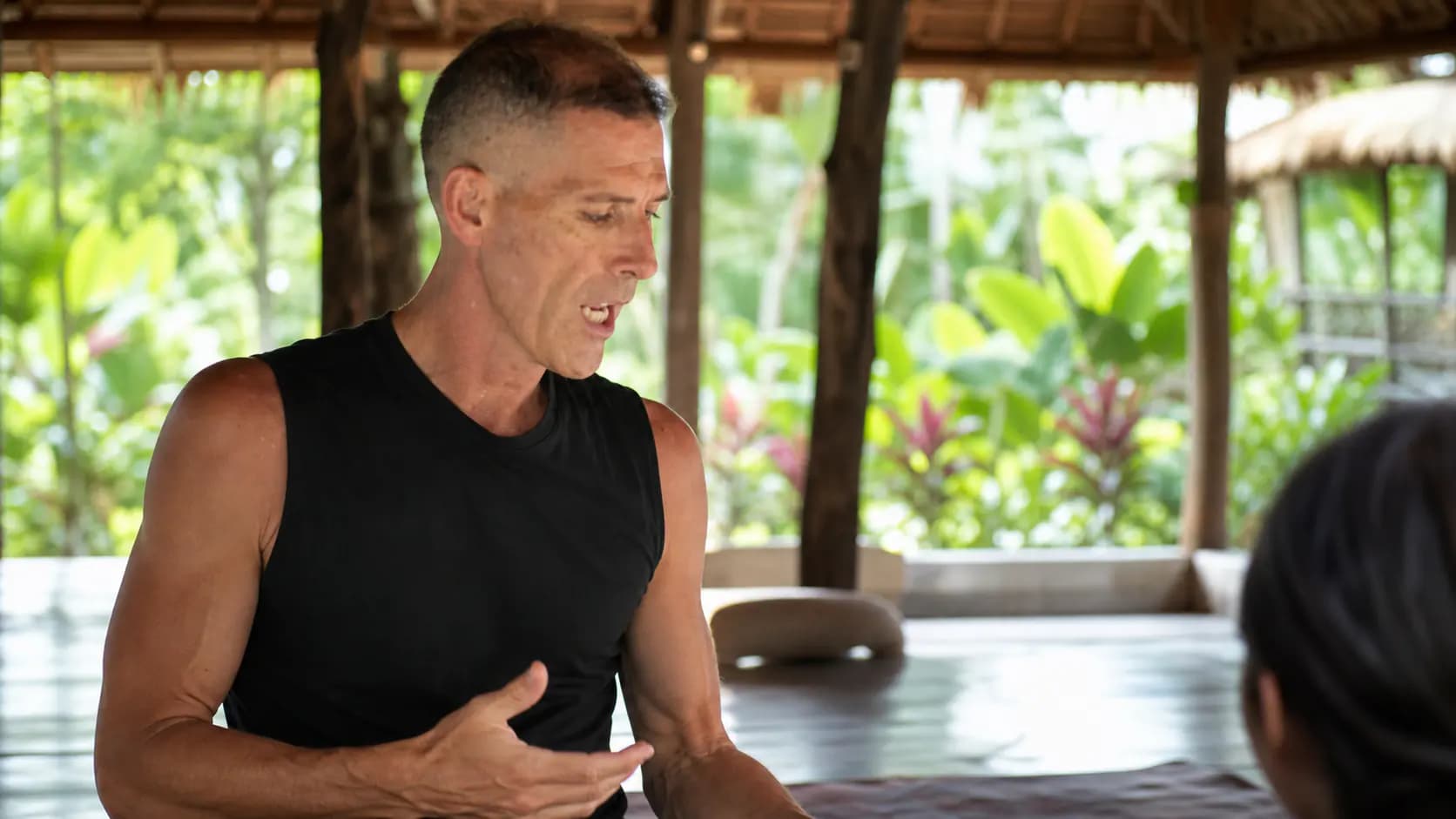
Mr. Ian, founder of YogaFX and Certified in Applied Neuroscience & Brain Health, designed the Nervous System Reset pillar.
It connects somatic movement with structured heat and hydrotherapy rather than presenting them as unrelated activities.
The aim is repeated support for regulation.
Grounding, movement, heat, recovery, sound, breathing, and group conditions appear within a day-by-day arc.
The language remains supportive rather than clinical: the programme offers structured opportunities to shift pace and body state, not a guaranteed neurological outcome.
The profile of Mr. Ian explains the credentials and boundaries behind this approach.
The Detox Retreat Bali guide shows how somatic work, nutrition, heat, and integration fit within the wider programme.
How to Evaluate a Nervous System Claim
Ask what the programme means by reset.
If the answer relies only on dramatic language, it may be a marketing label.
A credible explanation should identify the practices involved, their sequence, relevant evidence, limitations, safety considerations, and the qualifications of the people delivering them.
Check whether research cited for one population is being applied too broadly.
Evidence from PTSD therapy does not automatically prove a general wellness class.
Evidence from an 8-week depression study does not prove a single heated yoga session.
Sauna associations do not establish that every form of heat prevents disease.
Good evidence communication preserves the limits.
A citation should narrow a claim, not merely decorate it.
When a programme admits what a study did not test, that restraint is a sign of credibility rather than weakness.
For wider booking criteria, read Yoga Retreat Bali: The Complete Guide.
If work stress already feels familiar, Signs of Burnout You Might Be Ignoring explains when quiet changes deserve attention.
What Research Supports, and What It Does Not
Research supports the study of autonomic regulation and the role of body state in experiences of safety and threat.
It provides promising evidence for Somatic Experiencing in trauma-related care, identifies potential health associations around sauna use, and offers preliminary controlled evidence for heated yoga in depression.
Research does not establish a standard medical procedure called a nervous system reset.
It does not show that one Retreat permanently changes autonomic function.
It does not support replacing healthcare with wellness practices.
The responsible claim is modest but useful.
Structured body-based practices, supportive conditions, and carefully managed heat may support regulation and recovery.
Individual response varies, repeated practice matters, and the causes of chronic stress still need attention.
This article is for general information only and is not a substitute for professional medical advice.
If you are experiencing burnout symptoms or a serious mental health condition, speak with a qualified healthcare professional.