


If you are going to hand over a week of your life and trust someone to guide a structured burnout recovery Retreat, it is worth knowing who designed it.
Credentials matter, but so does how they are used.
This is the background behind Mr. Ian and the YogaFX method that shapes the 6-day experience.
This profile is intentionally factual.
It explains his teaching record, relevant training, and programme approach without turning a wellness credential into a clinical title.
It also clarifies what prospective guests should ask before booking, because trust should be based on information rather than biography alone.
Background and Credentials
Mr. Ian is the founder of YogaFX and an E-500 Hr RYT Master Trainer.
He has more than 12,000 hours of teaching experience.
His work has developed through years of direct teaching, observing how different students respond, and learning how to adjust instruction within a shared practice.
Beyond yoga training, he is Certified in Applied Neuroscience & Brain Health.
His continuing education accreditation connects with the International Coaching Federation and the National Board for Health & Wellness Coaching.
Those credentials are relevant to programme design, but they do not make him a doctor, therapist, or clinical practitioner.
The distinction is important.
Applied neuroscience can inform how a Retreat thinks about stress, attention, safety, habit, and recovery.
Yoga teacher training can inform movement, breath, pacing, and group instruction.
Neither should be inflated into medical authority.
The YogaFX Retreat is presented as a structured wellness experience, not diagnosis or treatment.
From Teaching Hours to Practical Judgement
A large teaching-hour figure only becomes meaningful when it improves decisions in the room.
Experienced instruction is visible in how a teacher offers options, notices when effort has become strain, communicates clearly, and adapts without making one guest feel singled out.
Practice creates pattern recognition.
A teacher who has worked with many bodies and experience levels has seen that the same instruction does not land the same way for everyone.
The purpose of experience is not to make a programme harder.
It is to make progression more deliberate and guidance more responsive.
That judgement matters in a mixed Retreat group.
Some guests arrive with a long yoga history.
Others are beginners, returning after injury, or carrying significant fatigue.
A coherent group programme needs enough structure to move together and enough range to avoid treating every participant as interchangeable.
Why YogaFX Is More Than a Name on the Schedule
Mr. Ian founded YogaFX and personally shapes the Retreat methodology.
The programme is not a collection purchased from unrelated activity providers and placed under one brand.
Its movement, workshops, recovery practices, and integration work are organised around one sequence.
Method needs continuity.
When the person responsible for the approach remains connected to its delivery, observations from one part of the week can inform the next.
That is different from moving between instructors who each see only one isolated session.
Prospective guests should still ask a practical question: who leads which sessions on the dates they are considering?
Mr. Ian shapes the structure, but guests should confirm the exact teaching schedule with the team before booking.
The Approach Behind This Retreat
Many retreat programmes begin with a list of activities: yoga in the morning, treatment in the afternoon, and a workshop when there is space.
Mr. Ian's approach begins with sequence.
The question is not only whether an activity feels good.
It is where that activity belongs in a week designed to move from arrival and grounding toward reflection, recovery, and integration.
The programme treats the week as one continuous arc.
A strong practice placed too early can compete with travel fatigue.
Insight without integration can disappear after departure.
Rest without examining the conditions that produced exhaustion may offer relief without direction.
The result is not a promise that every guest will experience the same change.
People arrive with different histories, responsibilities, and health considerations.
The Retreat offers a common structure within which those differences can be respected.
The Five-Pillar Method
The Retreat is organised around five connected pillars: Reset Mentally, Detox Physically, and Reboot Your Body, followed by Nervous System Reset and Dismantle Self-Sabotage.
Each pillar addresses a different part of the experience while remaining connected to the others.
Reset Mentally
This pillar creates distance from constant input and habitual pressure.
Workshops and reflection help guests notice the assumptions, decisions, and demands that have become automatic.
The goal is not forced positivity.
It is clearer attention.
Detox Physically
Within YogaFX, detox refers to a supported change in routine through food, hydration, reduced stimulation, movement, and recovery practices.
It is not a medical detox or a promise to remove toxins.
Reboot Your Body
Movement, heat, hydrotherapy, rest, and nourishment are arranged progressively rather than delivered as separate experiences.
The body is not treated as a machine that needs punishment for being tired.
The emphasis is sustainable participation.
Nervous System Reset
Somatic work, breathing, pacing, sound, and supportive group conditions are used to create opportunities for regulation.
The phrase describes the programme's intent and should not be read as a clinical claim that the nervous system is literally reset in 6 days.
Dismantle Self-Sabotage
This pillar brings attention to coping patterns and habits that may undermine recovery.
Insight is paired with Day 5 integration work so guests leave with a practical plan rather than a motivational peak.
You can see how the pillars unfold in the full 6-day itinerary, from the opening Welcome Puja through the final sunrise trek.
What Applied Neuroscience Means Here
Applied Neuroscience & Brain Health training informs how the programme considers attention, stress, habit and the relationship between mental and physical experience.
It does not turn the Retreat into a clinic, and it does not authorise diagnosis.
The practical value is in programme design.
Mental work is not separated from movement.
High-effort elements are balanced with recovery.
Integration is treated as part of the method rather than an optional conversation at the end.
This restraint matters for trust.
Wellness programmes can borrow medical language to make ordinary experiences sound more powerful.
YogaFX can state its relevant credentials plainly while maintaining the boundary between supportive wellness practice and licensed healthcare.
A Track Record Guests Can Examine
YogaFX reports more than 600 five-star reviews across Google, Yoga Alliance and YouTube from students and guests throughout Mr. Ian's teaching career.
Review volume is useful evidence of a long public track record, but it should not replace your own due diligence.
Look beyond the star count.
Read what reviewers describe, whether they discuss teaching quality and support, and whether their experience resembles what you need.
Reviews are strongest when they provide specific, independently accessible context rather than only praise.
The Yoga Retreat Bali complete guide provides a broader checklist for comparing programmes.
The Detox Retreat Bali guide also explains how to evaluate claims before paying a deposit.
Why Personal Attention Matters
A maximum group size of 20 does not automatically guarantee individual attention.
It makes individual attention possible.
What matters is whether the teaching team uses that scale to learn relevant considerations, observe participation, and make thoughtful adjustments.
Smallness has to change the experience.
Personal guidance should appear in the way questions are answered, options are offered, and the week's progression responds to the group.
It should not be only a number in marketing copy.

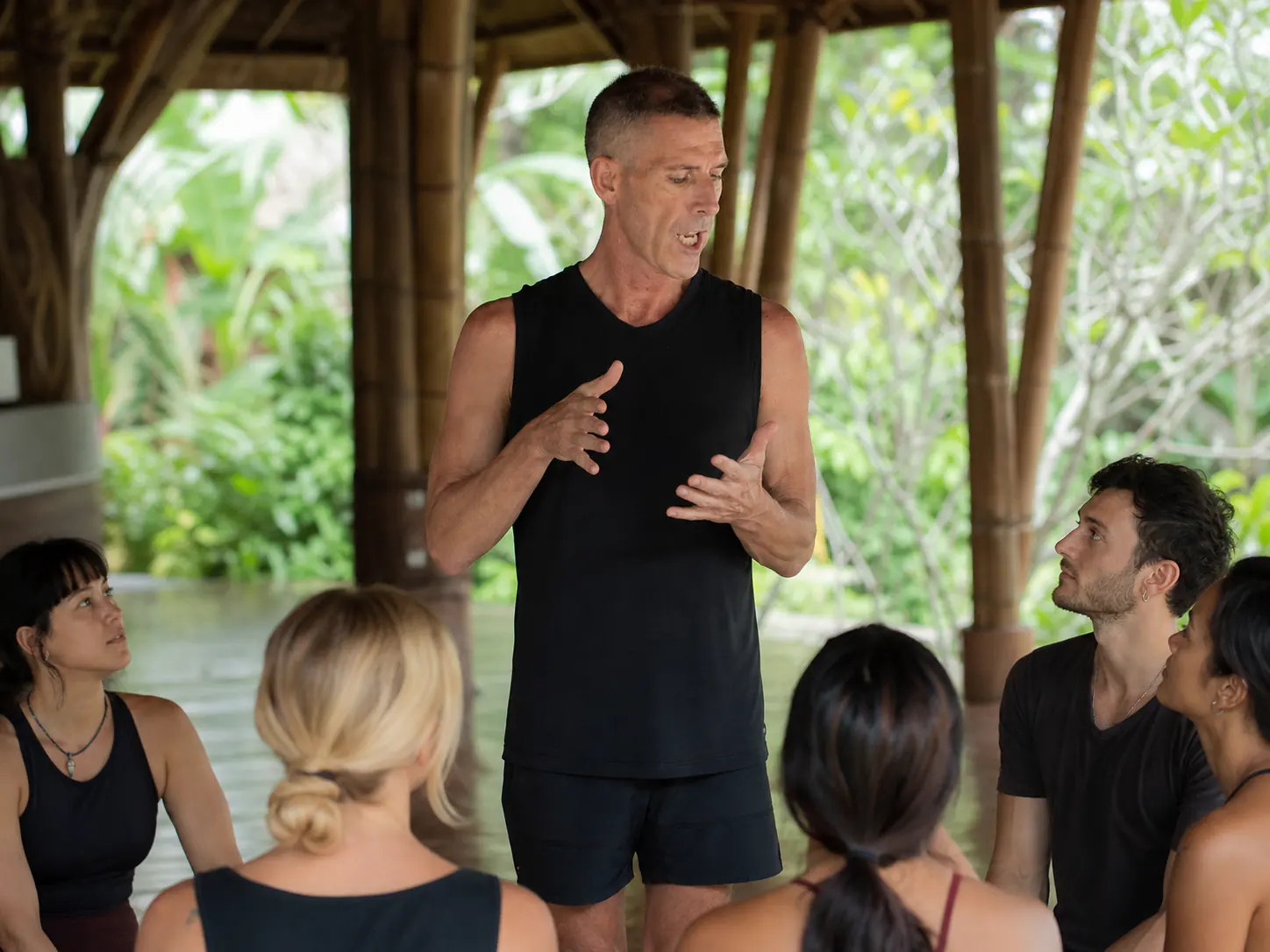
The one-to-one moments shown here represent attentive communication, not therapy.
Guests who are managing diagnosed physical or mental health conditions should consult their healthcare provider before booking and discuss relevant needs honestly with the Retreat team.
What to Confirm Before You Book
Ask which sessions Mr. Ian personally leads, who supports the others, how modifications are handled and what information the team needs before arrival.
Review what is included, the booking terms, and the daily sequence.
A credible programme welcomes specific questions.
It should explain both what it offers and what it does not.
The Retreat can support rest, reflection, movement, and recovery practices.
It cannot promise to cure burnout or replace licensed medical or mental health care.
If the method, boundaries, and itinerary fit what you are seeking, you can register your interest for the upcoming YogaFX Retreat in North Bali.
This article is for general information only and is not a substitute for professional medical advice.