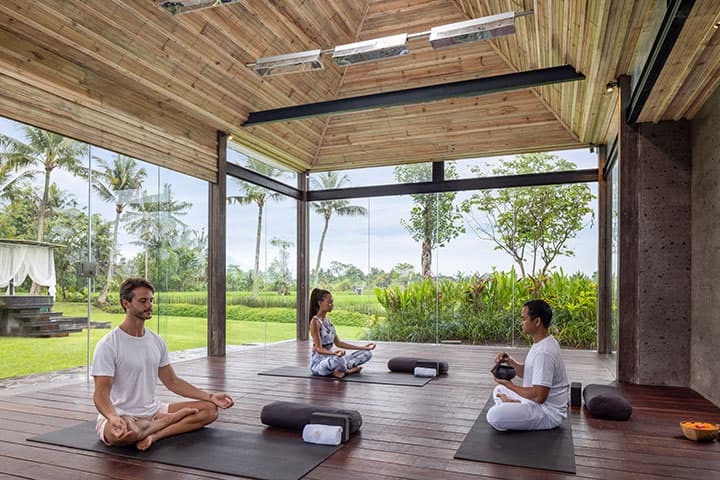


A professional burnout retreat is a structured programme for people experiencing prolonged work-related exhaustion, detachment or reduced capacity. It may provide protected rest, guided wellness practices, digital boundaries and return-to-work planning. Some programmes offer licensed clinical treatment. YogaFX is a non-clinical wellness retreat and is not a replacement for professional care.
If you are still working out what you need, begin with the private burnout self-check. It is a short reflection tool, not a diagnosis or clinical assessment.
Top Professional Burnout Programs in Bali
Professional burnout retreats in and around Bali range from licensed clinical programmes to non-clinical wellness retreats. Depending on the provider, programmes may combine mental health coaching, nervous system support, psychotherapy delivered by licensed clinicians and wellness therapies. These services are not interchangeable, so verify who delivers each element before booking.
YogaFX Burnout Retreat, North Bali Sanctuary
- Type: Six-day exclusive detox and burnout nervous system reset.
- Focus: A maximum of 20 guests, with guided somatic movement, digital boundaries, holistic rest and educational wellness sessions.
- Clinical scope: Non-clinical. The programme does not provide psychiatric diagnosis, psychotherapy or medication management.
- Next dates: January 31 to February 4, 2027.
YogaFX occupies the wellness end of this spectrum. Guests who need psychotherapy or clinical burnout treatment should choose an appropriately licensed provider.
How a Professional Burnout Recovery Retreat Differs
A burnout recovery retreat temporarily removes the meetings, notifications, commuting, caretaking and decision fatigue that can keep an exhausted person in a cycle of constant response.
A planned daily rhythm replaces that pressure with protected sleep, regular meals, gentle movement, reflection and restorative activities.
Burnout is not simply tiredness after a demanding week.
The World Health Organization describes burnout as an occupational phenomenon resulting from chronic workplace stress that has not been successfully managed. WHO does not classify burnout as a medical condition.
A retreat may support recovery, but it cannot diagnose symptoms or repair an unhealthy workplace on its own.
Persistent exhaustion, depression, severe anxiety, substance dependence or an inability to function should be discussed with an appropriately qualified healthcare or mental health professional.
How a Professional Burnout Retreat Works
Professional burnout retreats offer structured programmes combining rest, mental health coaching, wellness therapies and stress-reduction practices to help exhausted workers regain energy and clarity.
The exact level of care depends on the provider.
“Coaching”, “therapy” and “clinical treatment” are not interchangeable terms, so ask who delivers each service and which professional credentials apply.
A useful programme reduces decisions without filling every hour.
It may begin with an intake conversation about workload, sleep, health considerations and goals.
Guided sessions then alternate with meals, recovery periods and quiet time.
Toward the end, participants develop realistic boundaries and actions for returning home.

Wellness Retreat or Burnout Treatment Retreat?
A wellness retreat, coaching programme and clinical burnout treatment programme provide different levels of support. The word “retreat” does not establish whether licensed healthcare is available.
| Programme type | Typical scope | Provider | Appropriate starting point |
|---|---|---|---|
| Non-clinical wellness retreat | Rest, movement, nutrition, reflection and wellness activities | Wellness and movement practitioners | A stable guest seeking a structured pause |
| Coaching programme | Goals, habits, boundaries and work patterns | A suitably qualified coach | Planning, behaviour change and accountability |
| Clinical burnout treatment | Assessment and licensed psychotherapy, with medical services where offered | Licensed clinicians | Diagnosed conditions, substantial loss of function or clinical care needs |
YogaFX is a non-clinical wellness retreat. It does not provide psychiatric diagnosis, psychotherapy, medication management or addiction treatment.
When to Seek Professional Care Before Booking
Seek an appropriately licensed professional before booking when symptoms are severe, worsening or affecting basic daily functioning. A destination wellness programme may be unsuitable when a guest needs active clinical monitoring or urgent support.
- You are unable to manage ordinary daily activities or work safely.
- You are experiencing severe depression, anxiety, trauma symptoms or panic.
- You need alcohol or drug withdrawal support.
- You require medication changes or medical monitoring.
- You have thoughts of harming yourself or someone else.
In an immediate crisis, contact local emergency services or an appropriate crisis service where you are located. A retreat application is not an emergency or clinical assessment.
Professional and Caregiver Burnout: Similar Exhaustion, Different Pressures
A professional burnout retreat may attract executives, physicians, nurses, therapists, teachers, pastors and other people whose work combines responsibility with sustained emotional demand.
Caregiver, parental and “mom burnout” searches reflect a different context: unpaid care, interrupted rest, limited cover and responsibilities that may continue while the person is away.
These groups can share exhaustion without needing the same programme design.
| Situation | Pressure to consider | What to verify |
|---|---|---|
| Healthcare and therapy professionals | Shift work, emotional exposure, confidentiality and moral distress | Clinical support where needed, sleep protection and realistic return-to-work planning |
| Pastoral and community roles | Constant availability and responsibility for others | Privacy, belief-sensitive support and boundaries after returning |
| Parents and caregivers | Care cover, interrupted recovery and limited personal time | Travel feasibility, emergency contact arrangements and support at home |
YogaFX welcomes adult applicants but is not a profession-specific treatment programme. Applicants should assess whether a shared, non-clinical retreat matches their needs and whether suitable care or practical cover exists before and after travel.
Autistic, ADHD and Neurodivergent Burnout Are Not Interchangeable with Work Burnout
Autistic burnout, ADHD burnout and occupational burnout should not be treated as interchangeable labels.
The World Health Organization defines burnout specifically as an occupational phenomenon associated with chronic workplace stress. Neurodivergent communities may use burnout language for prolonged overload involving masking, sensory demands, executive strain or insufficient support across several parts of life.
A search for an autistic burnout retreat, ADHD burnout retreat or neurodivergent burnout retreat therefore requires more than finding a quiet location.
- Ask about sensory conditions, noise, lighting, heat, group size and opportunities to withdraw.
- Confirm whether schedules and instructions are predictable and available in advance.
- Discuss food, communication, mobility and reasonable modification needs before paying.
- Verify whether facilitators have relevant neurodiversity experience rather than assuming general wellness credentials are sufficient.
- Seek qualified assessment or support when exhaustion, loss of function, depression or safety concerns are significant.
YogaFX is not an autism or ADHD treatment programme and does not claim specialist neurodevelopmental care. Its application process can discuss practical needs, but acceptance is not a clinical assessment or a guarantee that every modification can be provided.
What to Expect at a Burnout Retreat
Mind-Body Activities
Daily yoga, guided meditation, breath awareness and nature walks can help establish a slower rhythm.
These activities are most useful when they are accessible, non-competitive and balanced with rest.
A credible provider should ask about injuries, mobility, pregnancy and relevant health conditions before recommending heat, cold immersion or strenuous activity.
Clinical and Holistic Care
Depending on the programme, support may include consultations with licensed wellness or healthcare professionals, nutritional guidance, massage, hydrotherapy, sauna and other restorative treatments.
Clinical care should be clearly identified and delivered by suitably licensed practitioners.
Holistic services can support comfort and reflection, but should not be presented as replacements for medical or psychological treatment.
Digital Detoxing
A retreat creates an environment free from routine work notifications, meetings and performance pressure.
Effective digital detoxing is usually planned rather than punitive: participants arrange work cover, tell family how emergencies will be handled and choose specific times when devices remain away.
This creates mental space while keeping genuine safety needs in view.

Executive Burnout Retreat or Corporate Wellness Retreat?
An executive burnout retreat is usually designed for an individual founder, director or senior professional carrying sustained responsibility.
Priorities may include discretion, decision fatigue, leadership pressure, digital access and a realistic plan for returning to a demanding role.
Some programmes provide private clinical treatment; others, including YogaFX, are shared non-clinical wellness experiences.
A corporate wellness retreat generally serves a team.
It may address collective stress, communication, connection and healthier working norms.
Team activities can be valuable, but employers should not use a retreat to place responsibility for systemic workload problems entirely on employees.
Confidential health discussions should remain separate from performance management.
Choose an individual format when personal recovery, privacy and tailored reflection are the priorities.
Choose a corporate format when the organisation is also prepared to examine workloads, expectations and team practices after everyone returns.
How to Compare the Best Burnout Retreats
The best burnout retreat is the one whose scope, pacing and support match the guest's actual needs—not the one with the most treatments or strongest recovery promise.
Use published facts to compare programmes:
- Clinical level: Is it licensed treatment, coaching or a non-clinical wellness retreat?
- Programme structure: Are rest, guided work and integration balanced across the stay?
- Leadership: Are facilitators named, and are their credentials relevant to what they deliver?
- Group environment: Are capacity, privacy expectations and personal-space options explained?
- Safety: Are screening, contraindications, emergency procedures and modification limits clear?
- Complete cost: Does the price clearly state accommodation, meals, transfers, sessions and exclusions?
- Return-home plan: Does the programme help guests translate a pause into sustainable boundaries?
A luxury burnout retreat may reduce logistical friction through private accommodation and concierge support. An affordable burnout retreat may reduce financial pressure. Neither price point proves programme quality or suitability.
Searching for a “Burnout Retreat Near Me”
A search for burnout retreat near me is a sensible starting point when travel time, family commitments or continuity with local care matter.
A nearby programme may make follow-up easier and reduce the stress of long-distance travel.
Location, however, should not outweigh the suitability of the support.
Use this checklist when comparing local and destination options:
- Scope: Is it a wellness retreat, a coaching programme or licensed clinical care?
- Credentials: Who leads each activity, and are their qualifications relevant?
- Pacing: Does the schedule protect sleep and unstructured recovery time?
- Safety: How are health screening, medication, emergencies and dietary needs handled?
- Privacy: What are the policies for group disclosure, data and photography?
- Integration: How will insights become realistic changes at home and work?
A destination retreat can be appropriate when distance itself helps interrupt familiar patterns.
A local retreat may be preferable when symptoms require ongoing professional care.
The best choice is the one whose scope matches your needs.
Popular Options and Locations
Burnout programmes are offered in countryside clinics, mountain lodges, coastal wellness resorts and tropical sanctuaries.
Rural and nature-based settings can reduce sensory load and make walking, outdoor reflection and regular sleep easier.
Urban programmes may provide stronger access to specialist clinical services and convenient follow-up.
Bali is a popular destination for yoga, holistic wellness and nature immersion.
Ubud provides extensive wellness infrastructure, while coastal areas combine spa experiences with ocean settings.
North Bali offers a quieter alternative for people who want greater distance from the busier tourism centres.
The YogaFX 6-Day Detox & Burnout Reset
YogaFX Retreats offers an exclusive 6-day Detox & Burnout Reset in a private North Bali sanctuary.
The programme is led by Mr Ian Terry, an E-RYT 500 yoga teacher certified in Applied Neuroscience & Brain Health with more than 12,000 teaching hours. These credentials support the programme's educational and wellness scope; they are not clinical psychology or psychiatry qualifications.
The retreat is scheduled for January 31 to February 4, 2027.
Attendance is limited to 20 guests to maintain a small, guided social setting.
The programme combines Somatic Decompression Yoga, Nervous System Reset Sessions, guided digital boundaries, cellular cleanse-inspired meals, heat and hydrotherapy experiences, sound healing, nature immersion, Balinese cultural practices and cognitive integration workshops.
No advanced yoga experience is required.
YogaFX is a wellness and educational retreat rather than a hospital, rehabilitation centre or psychotherapy service.
The application flow provides a place to discuss fit, relevant health considerations and what support the programme can realistically provide.
Guests needing diagnosis, medication management, withdrawal support or urgent mental healthcare should seek an appropriate clinical provider.
Duration, Rooms and Investment
The YogaFX professional burnout retreat runs for six days, with twin-share and single-occupancy pricing. The complete trip budget should also account for flights, insurance, personal spending and any nights outside the programme.
| Room option | Early-bird price | Full price |
|---|---|---|
| Twin share, per person | $2,499 | $2,799 |
| Single occupancy | $3,499 | $3,799 |
A $500 deposit is requested after an application is accepted. The remaining balance is due 60 days before Day 1, and a four-month instalment option is available during enrolment.
Review the confirmed retreat inclusions, read the payment and cancellation terms, or use the retreat budget calculator before applying.
Health disclaimer: YogaFX is a wellness and educational programme. It does not replace medical assessment, psychotherapy, psychiatric treatment, addiction care or emergency mental health support.
How to Make a Burnout Retreat Useful After You Return
The calm of a retreat is temporary unless the conditions around everyday life also change.
Before leaving, identify a small number of actions that can survive a busy week: a firm end to the working day, protected sleep, fewer unnecessary notifications, regular meals, delegated responsibilities or a conversation about workload.
Some people also need professional counselling, medical assessment, occupational health support or a change in role.
Treat the retreat as a structured interruption and planning environment, not a test of whether you can become more resilient to unreasonable demands.
Apply for the YogaFX Burnout Retreat
A well-designed burnout retreat should provide protected rest, appropriate guidance and an honest bridge back to daily life.
Explore the complete YogaFX programme, review the 6-day journey and read the detailed Bali burnout retreat guide.
If the non-clinical scope fits your needs, use the application flow to discuss suitability and support.